

The Harvard Happiness Expert’s Workout for a Happier Life (and Strong Arms)
Photo Courtesy of Jake Rosenberg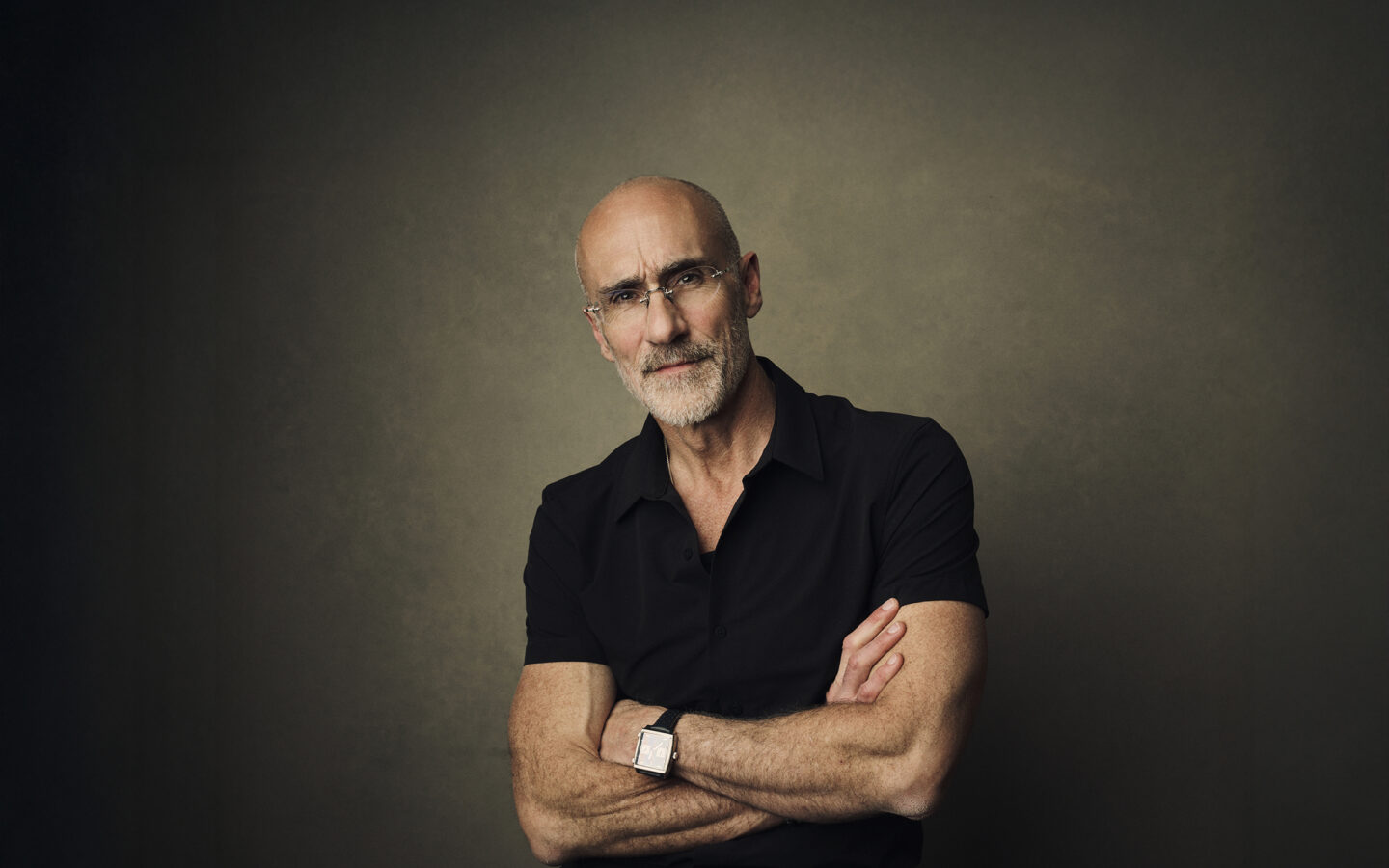
Harvard happiness expert Arthur Brooks hits the gym every morning to regulate his mood. Steal his workout for a stronger body and happier mind.
When we built the Super Age Games, we knew one of the eight trials couldn’t be measured in watts or reps. Decades of research, much of it from Harvard’s long-running studies of adult life, keep arriving at the same finding: the quality of our relationships predicts how long and how well we live, rivaling exercise and diet as a [lon-jev-i-tee]nounLiving a long life; influenced by genetics, environment, and lifestyle.Learn More: Longevity signal.
Few people have done more to translate that science into practice than Arthur Brooks, the Harvard professor and author, who has spent years teaching that happiness isn’t a mood we wait for but a set of skills we build, with connection at the center. His work is a big part of why we treat relational intelligence as trainable, testable capacity in our view of whole-human longevity.
It’s fitting that Brooks would be the one to help us bridge that gap between physical and mental health. If you’ve ever seen Brooks interviewed on a YouTube video or for a podcast, you know that the thought leader doesn’t just bring easy-to-follow, research-backed solutions for living a happier, more fulfilling life. He also brings a sleeve-straining pair of biceps.
“What I’m really working out for is the psychological, and that’s to say the neurobiological, benefit of it,” says Brooks, the PhD author of The Meaning of Your Life. The popping veins on his upper arms, he says, are just the happy byproduct of his daily gym routine.
And it is a daily routine. Brooks is in his home gym seven days per week for an hour, starting at the ungodly hour of 4:45 a.m., a mere 15 minutes after waking.
His every-morning lift, he says, is crucial to his well-being — for some reasons backed by science, and others backed by his own experience. The now-62-year-old researcher and author spoke with Super Age about why his workouts are so central to his happiness, and how you can capture the same benefits (even if you don’t work out before dawn). He also shared the arms-and-shoulders session he does each week to build those eye-catching upper arms.
Building Muscle, and Beating Back the Bad Thoughts
When Brooks was in his 30s and just starting to take exercise seriously, he sought workout advice from the men he thought seemed the sagest: The gym’s oldest lifters.
“I was starting to travel a lot for my work, and I would go to the oldest iron gyms I could find in every city. I would find the guys in their 70s who were ripped, and I would ask them to teach me,” he says. “The reason is because they were old and still fit for a reason… they’re not getting hurt, and they have good discipline.”
The old dogs taught him form, how to design his workouts, and strategies for reducing injury and staying mobile, like trading in barbell moves for dumbbells that let his shoulders move freely. In the ensuing years, Brooks said, he’s used their wisdom and his experience to build a set of habits that work — and they do work. Besides the pythons he’s packing, Brooks is lean, sitting around eight percent body fat. He’s brimming with energy, and says he’s been able to stay relatively injury-free.
That lets him stay in the game, and get what he says is his main benefit from exercise: mood management.
“My problem isn’t that I’m trying to get happier. I’m trying to manage negative affect,” he says. A personality that tends towards negative affect is basicallysomeone who tends to feel more negative motions overall, and may be more prone to certain mental health disorders. Exercising, he says, is a powerful tool against this, and against depressive symptoms in general.
“Anybody who works out hard in the morning is going to find that they have a clearer, better outlook on life because they’re not being distracted by a lot of the negative affect that they normally would,” he tells Super Age, stressing that your workout doesn’t have to be in the morning to have positive psychological effects.
“The worst thing you can do for mood management is to be sedentary. When you can get into the gym and do it, you should do it,” he says. “That’s 90 percent of it. Work out hard, and that’s 90 percent.”
The other 10 percent consists of minutia: the specifics of when and how he works out hard to align his efforts with well-being research: His workout first thing in the morning, he says, helps him naturally manage his daily levels of [kawr-tuh-sawl]nounA hormone that helps manage stress, energy, and alertness.Learn More: Cortisol, a powerful stress hormone. He focuses on [strength tray-ning]nounResistance-based exercise to build muscle and support healthy aging.Learn More: Strength Training, because it’s been linked to improvements in depressive and anxiety symptoms, and to better mood, even after a single session.
Brooks says his early morning workout also gives him a mental health benefit that isn’t necessarily backed by research, but his own sense of well-being and accomplishment: “I love having done the hardest physical thing of the day, first thing in the morning.”
Brooks’ Arms, Shoulders, and Happiness Workout
Since he’s exercising every day, Brooks doesn’t always do full-body sessions, giving him time to recover between workouts. He breaks his weekly routine into a revolving schedule of a push workout, a pull workout, a leg day, and an arms-and-shoulders isolation day, starting each session with 15 minutes of cardio to warm up. On his push and pull days, he prefaces the upper body workout with a single, two-exercise superset for his legs (alternating between two exercises for the prescribed sets, instead of doing all sets of one move, then all sets of the next move).
“I superset everything, because I’m rolling through everything for 60 minutes,” he says.
On his arm and shoulder day, the workout has two phases: A giant set consisting of a three-exercise circuit, moving from a shoulder move to a biceps move to a triceps move. After two rounds of it, he breaks for two minutes of stretching or planks: A two-minute cobra pose, a two-minute plank, or back extensions.
Once he’s finished the tri-sets, he does a few sets of biceps and triceps moves using [bluhd floh]nounThe movement of blood through the circulatory system, delivering oxygen and nutrients to organs and tissues to support energy, healing, and overall health.Learn More: Blood Flow restriction, or BFR. This process, where bands or cuffs cut off part of the blood supply to a muscle, lets lifters build more muscle with lighter weights.
“To keep [muh-suhl mas]nounThe total weight of muscle in your body, critical for longevity.Learn More: Muscle Mass, you need to move a significant amount of weight around,” he says. “On arm day, that’s hard because you’re going to hurt your joints when you get older.”
The cuffs, he says, are his tickets to the gun show without the added elbow pain.
Try Arthur Brooks’ Workout
Part 1: Giant Set
To align your routine with Brooks’ typical set, perform each exercise until you feel you could do three more repetitions, then stop and move to the next exercise in the trio without resting. After performing all three moves twice, rest for 2 minutes. Do this 3 times, for 6 total rounds of the tri-set.
Exercise A: Incline Dumbbell Curl
1. Lie face up on an incline bench holding dumbbells in each hand, your arms hanging straight down from your shoulders.
2. Keeping your shoulders back, your head against the pad, and your feet planted on the floor, bend your elbows to lift your hands up to your shoulders, your palms facing the cap of your shoulder. Squeeze your bicep at the top.
3. Lower your arms and repeat.
Exercise B: Triceps Pushdown
1. Set a rope attachment on a cable stack with the anchor set high. Stand in front of it with soft knees, and grab the ends of the rope with your hands, palms facing in.
2. Keeping a tight core and squeezing your butt, bring the rope in front or your chest so your elbows are bent and your forearms and hands form an “up arrow” shape.
3. Press the rope down with both hands until your arms are straight.
4. Control the weight back to the top of the move, and repeat.
Exercise C: Dumbbell Overhead Press
1. Stand with dumbbells at your sides with your feet shoulder-width apart, your chest proud.
2. Curl the dumbbells up to your shoulders so your palms face each other.
3. Maintaining an upright posture, press the dumbbells overhead until your elbows are almost straight.
4. Return the weights to your shoulders, and repeat.
Part 2: BFR (or not!)
You don’t need to use BFR for this section of the workout. If you are curious about it, consult with a trainer who’s well-versed in the procedure first for safety.
In this section of the workout, Brooks does four sets of the first exercise, then moves to four sets of the second exercise. Complete 30 reps of the first set of each move, then 15 reps of sets 2-4. Rest 30 seconds between sets.
Exercise A: Preacher Curl
1. Sit tall at a preacher curl bench with your knees bent and feet flat on the floor. The angled preacher pad should fit snugly under your armpit.
2. Hold dumbbells at arm’s length with an underhand grip, palms facing up. Each upper arm should be in line with your forearm so that when your elbow is extended, your arm forms a straight line from your shoulder to your fingers.
3. Keeping your palms facing up, bend your elbows to bring the dumbbells up towards your shoulders. Don’t go all the way up, though! Stop when your biceps are at peak contraction, around when your forearm is perpendicular to the floor. This will keep tension on the biceps instead of letting them go slack.
4. Squeeze the biceps at the top.
5. Control the weight as you lower back to the starting position, finishing with your elbow just slightly bent so you don’t overextend the joint.
Exercise B: Overhead Cable Triceps Extension
1. Anchor the cable up high with the rope or a straight bar attached. Stand in front of the anchor point, facing away. Grab the bar or rope with both hands, palms facing in with the rope, or away from you with the straight bar.
2. Lean forward slightly at the waist, keeping a flat back, and place one foot in front of the other, as though in a lunge position. Hold the bar or rope behind your head with bent elbows.
3. Keeping your upper arms stationary, straighten your arms so the cable resists you.
4. Return to the bent arm position, and repeat.
Read This Next:
The information provided in this article is for educational and informational purposes only and is not intended as health, medical, or financial advice. Do not use this information to diagnose or treat any health condition. Always consult a qualified healthcare provider regarding any questions you may have about a medical condition or health objectives. Read our disclaimers.
Written By:
