


Why the Healthiest Meals Are Shared Between Friends (and Generations)
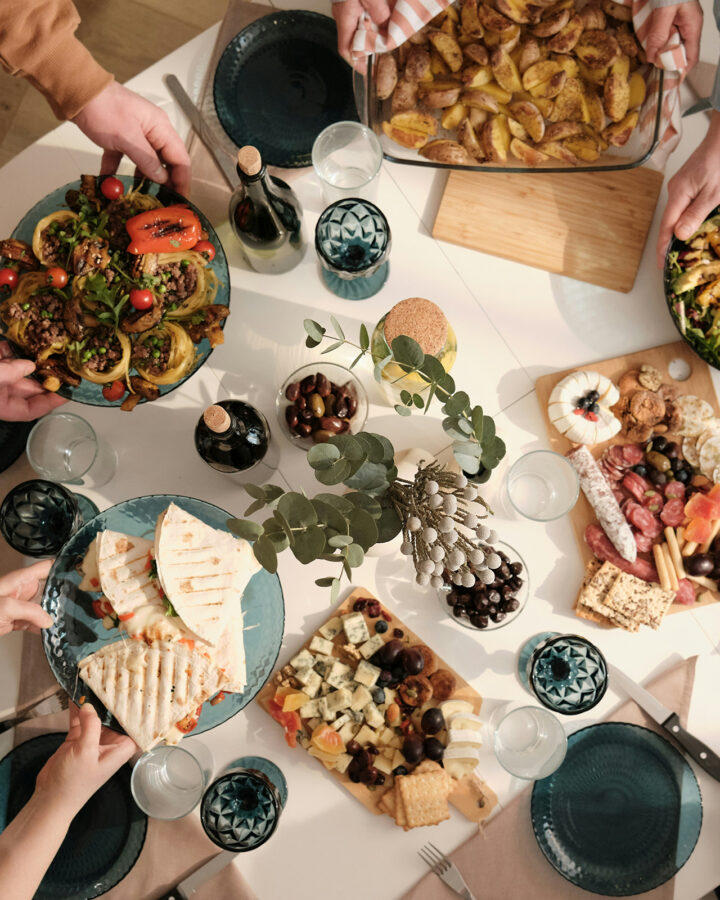
Padma Lakshmi explains how big batch cooking could help you live a longer, happier life.
For Padma Lakshmi, a home-cooked meal shared with family or friends is greater than the sum of its parts. Yes, the ingredients and preparation matter for your health and [lon-jev-i-tee]nounLiving a long life; influenced by genetics, environment, and lifestyle.Learn More: Longevity. You can read about that here. But just as important is whether those same meals support the social ties in your life. (Research backs her up: the U.S. Surgeon General has called loneliness and isolation a public health epidemic, with risks spanning from chronic illness to premature mortality.)
I know this because last week, Lakshmi joined doctors from NYU Langone onstage at Hearst Tower in New York City for a conversation about food as a longevity tool. While we, the audience of journalists and medical professionals, were certainly all reminded to eat our vegetables, the most important recurring theme had more to do with social rituals than sustenance itself.
“I think the two things that we use as human beings to survive are food and love,” Lakshmi says. “It’s nourishing physically, but it also, I believe, has a lot of other value than just feeding our bellies and giving us enough calories.”
If that sounds just a bit vague, her approach to bringing people to the table and making the most of the meal are not. The chef, cookbook author, and TV host says she uses a handful of dependable strategies for making her home cooking reliably healthy, immediately inviting, and workable for the busy schedule of a multi-hyphenate celeb.
Padma Lakshmi’s 9 Whole-Human Healthy Cooking Tips
Ask Padma Lakshmi what makes a meal healthy, and she’ll talk about more than what’s on the plate. She’ll talk about who’s around it, who helped make it, and who gets the leftovers. Her approach treats cooking as care for your body, your family, and your community all at once. It doesn’t require more time in the kitchen, just a little more intention. Here are nine ways to bring her philosophy home.
1. Cooking for four is as easy as cooking for two.
A generous invitation takes an already healthy meal and adds another layer of benefit. That’s why, even if you don’t live in a large household, Lakshmi recommends cooking as though you do. “It’s just as easy to cook for four people as it is to cook for two,” she says.
Her holidays reflect that philosophy. “Whether it’s Thanksgiving or Christmas, I’m Indian, so I tend to cook double the food that I need anyhow. Not all of it fits in the fridge. So, we make sure that before we sit down to eat, we take a plate of food to our neighbors and doormen if they have to work on that day.”
2. Save some of the cooking for your guests.
When you host at home, you may feel pressure to have everything ready by the time your guests arrive. Lakshmi says it’s actually better to save some work for your visitors.
“Social connections are really food for our souls as well, and breaking bread with someone else is a great way to maintain connection. But so is preparing food,” she explains. “In my house, you take off your shoes before you come, and just the act of being barefoot, I think, makes everyone a little bit looser. I will often pair two people who don’t know each other and say, ‘Can you make the salad for me?’ I know how to make a salad. I don’t need help. But I put all the stuff out to interact because it’s a good way to break the ice.”
3. Get the kids involved, too.
How do you raise a healthier nation? Start early, Lakshmi suggests. “The best gift you can give your child is a knowledge and love of food, because that is a gift that keeps giving to your child’s health long after you’re gone from their lives. And it’s never too early. I think about my grandmother — she would sit me on the floor when I was four years old and she would make me break the ends off of beans. I probably, a lot of the time, made more work for her but I like that she did that.”
The benefits went beyond her developing a love of healthy food and cooking. She says she never felt more connected than when she was brought into her family’s world while prepping meals together. “The kitchen became a place of magic for me. It was a place where the women exchanged gossip and made all the decisions. I got to hear all kinds of adult conversations that I wouldn’t have if I was off playing by myself.”
4. Don’t skimp on (or hide) your vegetables.
Her next tip falls right in line with the USDA’s nutritional recommendations: half every meal should be made up of fruits and veggies, with the other half consisting primarily of whole grains, protein, and healthy fats. Better still, she says, if those veggies are the stars of the meal — especially if you’ve got kids in the home.
“I don’t believe in masking [vegetables] or duping your kids. Because I think you want to make vegetables something they want to eat from day one. I know we all need to parent the child we have and children come in different packages, but I try to put 50% fruits and vegetables on every plate. Even if I’m making a simple dal with lentils I will add a big handful of baby spinach or some shredded kale to that. I’ll make a big kale salad and before I dress it I’ll take some out and add it to something else.”
5. Protect family dinner, and un-install Uber Eats while you’re at it.
When her daughter was younger, Lakshmi always kept one simple rule: at mealtime, homework and devices go away to preserve a face-to-face family dinner.
“You ate what was made that day for the evening meal, and if you didn’t like it and there were leftovers, you were welcome to heat those up, or you could scramble an egg, have some cucumbers, carrots, and ground peppers wrapped in a tortilla.”
Delivery apps have made that harder, she acknowledges. “I don’t want her to order that food and disappear into her bedroom,” she says of her daughter.
6. Prep like a chef.
Another of Lakshmi’s tips is one restaurant cooks rely on: mise en place. “They’re not chopping that carrot up before they make it to order for your table. You know the things that you reach for every week, so just chop those up and put them in baggies or containers.”
Going a step further helps. “Just cook them a little bit gently in something neutral, just salt and… some fat… so that you can add them to your Mexican meal, your Moroccan meal, your Indian, Italian, whatever you’re cooking.”
She also keeps jarred ginger and garlic paste in her fridge door. “Of course fresh is better. But you know if it makes you cook a fresh meal and you’re just using that, that saves you a lot of time.”
7. Build a rolling meal.
Inspired by Tamar Adler’s book An Everlasting Meal, Lakshmi cooks in a chain. Roast a whole chicken on Sunday, eat the thighs and legs Monday, then “break the chicken meat up and use it in a big salad, or make chicken salad with a little mayo that you can put in your lunchbox.”
Scraps go into a freezer bag. “When you have enough of those, you make stock with your celery tops and your parsley stems.” She admits it feels odd at first. “You have this bag of bones in your freezer, but… then it works.”
That stock becomes the base for the week, with leftover rice, noodles or vegetables. “If you don’t even have any chicken left, just poach an egg in it while it’s boiling.”
The point isn’t perfection. As Lakshmi puts it, “a simple meal… made at home is much better than anything that you’re going to order.”
8. Reduce waste.
Much of Lakshmi’s cooking philosophy seems rooted in grander ambitions for how we should be living. Zooming out, she says one of her top priorities while cooking is to reduce waste — another problem better solved through community.
“Somebody else will say, ‘oh, I got this in my community basket of vegetables, and there’s no way I can eat all these rutabagas, so it’s just another way to pool your resources,” she says. “Even if you can afford all the food you need, there’s a lot of waste that happens, and I think just being conscious and mindful of not wasting that much and buying less is also not only better for us and our wallets with food prices going so high, it’s also better for the environment. As I age, I’m thinking about what kind of planet I’m leaving my daughter and her children.”
9. Don’t wait until someone needs help.
We all know the value of community support when times are hard, and that’s something Lakshmi says she’s intimately familiar with. When her mother fell last fall, triggering “a cascade of issues,” others pitched in, often bringing meals and groceries as gestures of support.
Her advice is to start before a crisis. “You don’t have to wait until someone’s sick to do that… It shouldn’t be just when you need it,” she notes. It also shouldn’t be reserved for your closest connections: “Sometimes you just have to break the glass a little bit and introduce yourself,” Lakshmi says.
Behind Her Philosophy: Care Is Our Greatest Commonality, and Maybe Our Greatest Hope
Lakshmi’s view of food as fuel, medicine, community, and even social change comes from her upbringing, and from Taste the Nation, which took her town by town across the country to understand people through what they eat. What stayed with her was “how similar people are, even if their political beliefs are different, or they eat different foods.”
One of those commonalities is now her own daily life. Like roughly a quarter of U.S. adults, according to a 2025 Pew Research Center survey, Lakshmi is part of the sandwich generation, caring for her teen daughter and her aging mother at once. “As a single parent, all of that is now falling on my shoulders,” she says. “I can tell you that even if I’m feeling good, if my kid isn’t feeling good or my mom isn’t feeling well, that really affects the stress that I have on any given day.”
Cooking is how she cares for all three of them, herself included. And keeping generations close pays off in every direction. It “has a positive effect on our children, to be influenced and parented by different members of the family and different generations in the same house,” she says. “I think that hopefully makes everybody a little bit more broad-minded.”
The data backs her up. Despite the strain, sandwiched adults are more likely than others to say they’re very satisfied with their family life (48% vs. 43%).
That kind of connection is a counterweight to a culture Lakshmi sees as “so very focused on the ‘me’ of it all.” She isn’t calling to tear the system down. She just wants it to work “in a more humane way, where we are thinking about our healthcare and our food systems, and how we can pool our resources as communities in this country to help each other.” That means community centers, exercise, and carpools that keep older adults socially connected.
Underneath our differences, she believes, we all want the same thing. “I hope for our country that we can focus on those aspects of our culture, the things that we all share… the desire to nourish and educate and love our children, so that they exceed what we were able to do, the ability to take care of our loved ones and our elders as they age.”
Cheers to an invitation well worth accepting.
Read This Next:
The information provided in this article is for educational and informational purposes only and is not intended as health, medical, or financial advice. Do not use this information to diagnose or treat any health condition. Always consult a qualified healthcare provider regarding any questions you may have about a medical condition or health objectives. Read our disclaimers.
Written By:
