

This Chiropractor’s Message to Women: Build
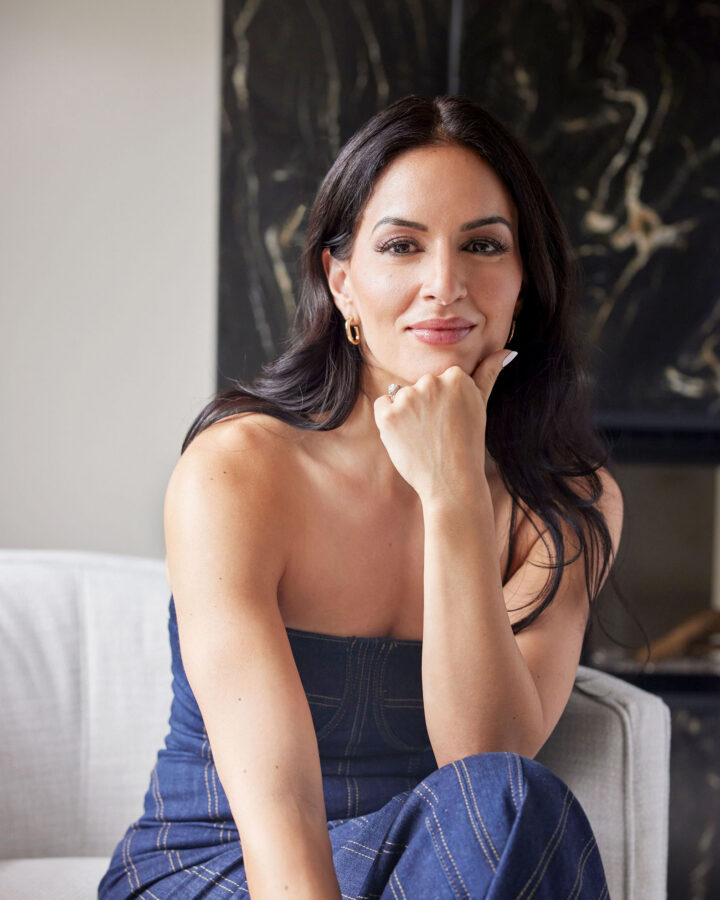
Dr. Stephanie Estima wants women to embrace aging, instead of fearing it, with habits to build a body they can trust.
Stephanie Estima walked up to a grocery store checkout counter, and the cashier was gushing about her chiropractor customer’s figure.
“She was like, ‘oh my gosh, you’re so beautiful. Are you a dancer? What’s your program? Tell me what you’re doing,’” Estima remembers of the experience in the early 2000s. The effusive praise for her look was thanks to her preparation for a National Physique Committee (NPC) bodybuilding show, where she’d compete in the “figure” category. Then, in her early 30s, Estima was carrying just 11 percent body fat.
She may have looked great, but she felt terrible.
“I hadn’t had my period in two or three months at that point. I was hungry. My hair was falling out,” Estima remembers. “There was this mismatch in terms of being rewarded socially for how I looked, but on the inside, being completely miserable.”
The experience convinced Estima to start convincing herself, and other women, to change their view of health and their goals for their bodies.
“We’ve always sort of thought when I want to ‘get healthy,’ it’s just a code word for being skinny … I want women to stop being losers. Stop trying to lose all the time,” she says, “and instead think about everything you can build. Can you build more muscle? Can you build more bone density? Can you build more connective tissue capacity? Can you build more confidence in your own body’s capacity?”
That’s the message behind the Toronto chiropractor’s latest book, Nothing to Lose. In it, she argues that women shouldn’t have to choose between a body that looks great and a body that works for the long haul.
“Yes, have the aesthetics, but also train for your 60-year-old body, your 70-year-old body, your 80-year-old body,” she says. “If you’re sacrificing the architecture of muscles, bones, connective tissue now just to be skinny, you’re going to pay for it in 20 to 30 years. There’s a way to have both.”
Estima strives for both in her own training, she’ll test the now-48-year-old body she’s built for the future at the Super Age Games, where she’ll be a Founding Athlete as a member of Team Timeline.
Building Power, moh-bil-i-tee]nounThe ability to move freely and easily through a full range of motion.Learn More: Mobility, and a Body She Can Trust
One Tuesday, a patient made Estima’s heart sink. The 42-year-old client told the chiropractor that at her son’s eighth birthday party, she couldn’t bring herself to join him on a trampoline, despite the little boy’s pleading. The reason she stayed on the sidelines? She was worried about bladder control, and about rolling her ankle.
“I remember thinking, ‘God, at 42, you’re telling me you’ve resigned yourself to this idea that you don’t trust your pelvic floor … and you also don’t have trust in your joints,’” Estima, herself a mother of two, says. “How can we reimagine what the body can do as it ages? Because yes, there are changes … but there are strategies you can employ to help strengthen those areas so your body can rise to the demands of your life.”
That means training the pelvic floor to maintain its integrity. Incorporating joint mobility and [bal-uhns trey-ning]nounExercises that improve coordination, reduce fall risk, and enhance mobility.Learn More: Balance Training into workouts to reduce fall risk and trust your ability to move. Maintaining [muh-suhl mas]nounThe total weight of muscle in your body, critical for longevity.Learn More: Muscle Mass to fight off [sar-koh-pee-nee-uh]nounAge-related loss of muscle mass and strength.Learn More: Sarcopenia, the 1 to 2 percent annual decline that leads to frailty and increased disease risk. And training for power—not just creating force, but creating it fast—since a disproportionate amount of the muscle lost to sarcopenia is from fast-twitch fibers, the kind we need during moments of heavy exertion … like trying to catch ourselves before we fall.
Estima incorporates all these ideas in her own training each week: In addition to four to five [strength tray-ning]nounResistance-based exercise to build muscle and support healthy aging.Learn More: Strength Training sessions per week, she does pilates once per week, helping to train her core and pelvic floor stability. She includes mobility work, especially for her ankles, which can get tight, at the end of each workout she does. She does one or two high-intensity interval training sessions per week, including a Norwegian 4-by-4 workout, to improve her [vee-oh-too maks]nounA measurement of how much oxygen your body can use during exercise.Learn More: VO2 Max.
And she starts each strength workout with some explosive movement to train and maintain her muscles’ power. Often, power training involves movements that can make you feel like you’re sticking out a little at the gym, like noisy medicine ball slams and ostentatious squat jumps.
If you’re afraid you’ll feel a little sheepish with moves like these, take your power cues from Estima’s method: She performs the same exercises she’ll do during her “regular” workout, but with each rep happening faster with a much lower weight.
“Let’s say I can do a 100-pound squat. I would bring the weight down to 50-60 pounds,” reducing the load by 40-50 percent. With this reduced weight, she’ll go down into the squat slowly, then press back to standing as quickly and forcefully as she can, almost leaving the floor. She’ll do one or two sets this way to start compound exercises like squats, deadlifts, and presses, then bump the weight back up for “normal” sets where she’s trying to increase her total weight each week.
While she’s moving weights fast, one thing Estima has added in her mid-40s is the ability to slow down. While she and other hard-charging women grew up with an ethos to train longer and harder, she’s learned to value rest.
“When you think you’re superhuman and not part of the human species and push your physical limits beyond what they’re capable of, you start picking up injuries,” she says. “You are deserving of rest. You don’t need to earn it. That is what helped me reach the next level in terms of my performance.”
Crushing The Fear of Aging
When she was still a student, one of Estima’s instructors told her that her hands were on the small side.
“Yes, they’re small. But they’re mighty,” she says. Still, she’s concerned that her mini-mitts could impede her in the [grip strength]nounA key marker of strength and predictor of longevity.Learn More: Grip Strength challenges at the inaugural Super Age Games. “I often have just trained for years with grips. But now I’m doing pull-ups without grips. I’m doing my dead hangs. I’m doing switch hangs … it’s been very humbling to see how much I can increase my grip strength before the Games.”
She’s more confident about what she’s built for the other events: Her weekly sprint cardio sessions have helped her VO2 Max climb. Weekly pilates sessions have honed her balance. And all those strength training sessions means Estima trusts her [fuhngk-shuh-nl strength]nounStrength that translates to everyday tasks and movements.Learn More: Functional Strength.
Estima’s not afraid of these events. And she hopes that her role as a Founding Athlete will help other women feel less fear about aging.
“It’s my hope in participating that women who are watching, irrespective of age, will be proyd that an almost 50-year old is participating in these Games. Like, ‘if she can do it, I can totally do it,” she says. “It’s never too late to start and really not fear getting older, because it truly gets better and better as long as you have the right strategies in place.”
“One of the things I want to demonstrate for women who have all been taught to be petrified of aging is that you’re just like fine wine,” she says. “You just get better with time.”
Read This Next
The information provided in this article is for educational and informational purposes only and is not intended as health, medical, or financial advice. Do not use this information to diagnose or treat any health condition. Always consult a qualified healthcare provider regarding any questions you may have about a medical condition or health objectives. Read our disclaimers.
Written By:
