

The ACSM Guide to Meeting 3 Common Exercise Goals
Mihajlo Ckovric - Stocksy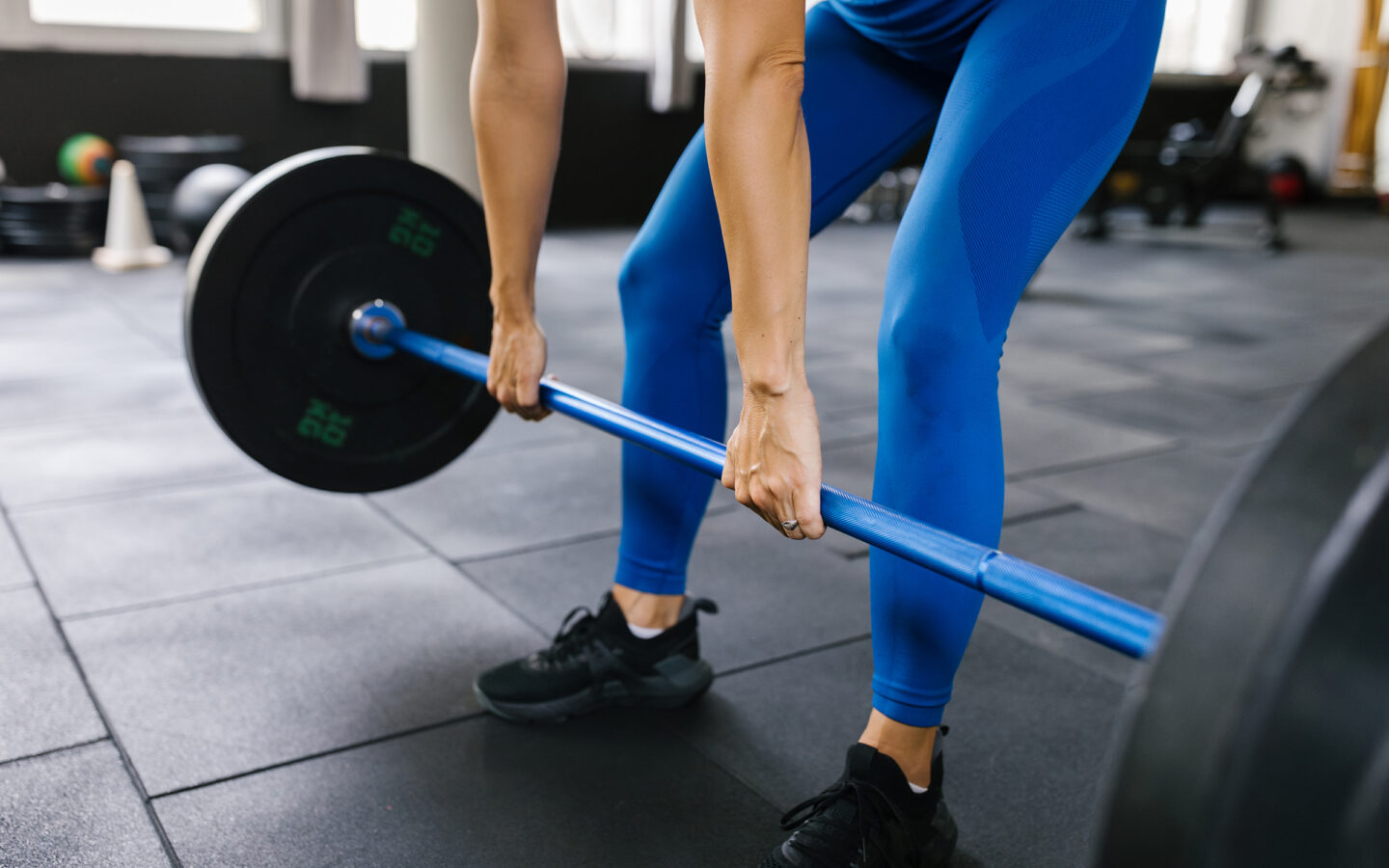
In a new study, the largest sports medicine and exercise science organization in the world unlocks the secrets to three key exercise goals.
If I had infinite money, getting a personal trainer would be at the very top of my list. They teach you good form and keep you consistent (spending the money means you’re more likely to show up at the gym). But there’s another benefit, too. I like the idea of having a professional in the room to help translate my big picture goals — strength, muscle, moh-bil-i-tee]nounThe ability to move freely and easily through a full range of motion.Learn More: Mobility — into step-by-step action plans. For me, a workout without a clear purpose is just that much more of a slog, and if I’m rich rich? Well, then I’ve also got a massage to get to, and I’d like to be in good spirits when I get there.
Realistically, though, you don’t need someone holding your hand through each workout to set meaningful goals and achieve them (good news, since I don’t see a personal trainer in my budget anytime soon). The latest American College of Sports Medicine (ACSM) Position Stand, an update to their 2009 Position Stand and a meta-analysis of 137 systematic reviews, identified three key goals that people commonly set and suggests a clear path forward for each one. As I dip my own toes into [strength tray-ning]nounResistance-based exercise to build muscle and support healthy aging.Learn More: Strength Training after years of gravitating towards cardio, I’ll be taking these insights with me to build a more targeted, less arduous, plan. Turns out, it’s surprisingly simple.
What the Research Says to Do
This latest paper from the ACSM, the largest sports medicine and exercise science organization in the world, looks at the impact of resistance training prescription on muscle function and muscle building. The researchers included data from more than 30,000 healthy adults who had completed between six and 52 weeks of resistance training exercises (in addition to data from non-exercise control groups).
One finding is major, but not surprising: the study confirms that resistance exercise works, full stop. It improves strength, muscle size, power, balance, walking speed, and general physical function. If you quit reading now (don’t!) you can walk away knowing that any resistance training exercise, performed safely, is always better than none.
The more useful insight is the fine print on how to train for specific outcomes. It turns out the “best” way to train depends heavily on what you’re optimizing for:
- Want raw strength? Lift heavy (80%+ of your one-rep max), through a full range of motion, 2 to 3 sets. Do it early in your workout (when you’re still feeling fresh), at least twice a week.
- Want bigger muscles ([hy-pur-truh-fee]nounThe increase in muscle size through training.Learn More: Hypertrophy)? Volume matters more than intensity, so aim for 10+ sets per muscle per week, and include eccentric overload (which emphasizes the lowering/lengthening phase of a lift).
- Want power (speed + strength combined)? Go moderate on load (30 to 70% of max), keep volume lower, and prioritize explosive, fast-concentric movement. Think Olympic lifts.
What the Research Says Not to Do
Besides offering a prescriptive workout plan for each goal, the study also touches on the fitness practices that were not consistently linked to better performance. “Training to momentary muscle fatigue, equipment type, exercise complexity, set structure, time under tension, [bluhd floh]nounThe movement of blood through the circulatory system, delivering oxygen and nutrients to organs and tissues to support energy, healing, and overall health.Learn More: Blood Flow restriction, and periodization did not consistently impact training outcomes,” the study states.
This part deserves a more nuanced conversation, suggests Brian Murray, a fitness coach and the founder of Motive Training.
“Before anyone reorganizes their week around this paper, it helps to know what kind of document it is. The ACSM Position Stand is a summary of other summaries, which means the panel read a large body of existing reviews and reported where those reviews agreed,” he says. “When the reviews lined up, they gave a clear recommendation; when they contradicted each other, the variable gets listed as not consistently affecting outcomes. However, that doesn’t mean they are unimportant variables.”
That said, for those of us actively looking for a simpler training regimen, the findings offer science-backed permission to stick a little more closely to the basics. The research shows that if you’re otherwise thoughtful about your goals and strategy, you don’t necessarily have to concern yourself with extraneous variables. For most people, those are just bonuses.
“As a sports medicine physician who has also been lifting consistently for over 20 years, that’s the part that stuck with me: everything the study says you can stop worrying about,” Dr. Shady Hassan, MD, a board-certified interventional pain and sports medicine physician, tells Super Age. “Fitness culture and product marketing sell complexity: training to absolute failure on every set, chasing hyper-specific time under tension, blood flow restriction, elaborate periodization schemes. The study lines up with what I see in the clinic and on the gym floor. None of that consistently changes results for most people.”
The physician describes this as a “freeing” form of simplicity — and one that could remove barriers to getting started. “You don’t have to drain your nervous system or overcomplicate your routine to make real progress,” he says. “Load is what builds strength and volume is what builds size. Speed and intent build power. Those levers do about 90% of the work.”
The Best Workout Goal for [lon-jev-i-tee]nounLiving a long life; influenced by genetics, environment, and lifestyle.Learn More: Longevity Fitness
Each of the three goals — strength, muscle gains, and power — qualify as forms of longevity fitness, but we wanted to know: Which is most directly tied to a longer lifespan and [helth-span]nounThe number of years you live in good health, free from chronic illness or disability.Learn More: Healthspan? The experts we spoke to agreed that power training has a leg up above the others.
“Power declines nearly twice as fast as maximal strength after middle age, and it has consistently been shown to predict independence, mobility, fall risk, and even mortality better than strength alone,” explains Dr. Mark Kovacs, PhD, FACSM, CSCS, a performance physiologist and longevity expert. “Strength is absolutely essential. [muh-suhl mas]nounThe total weight of muscle in your body, critical for longevity.Learn More: Muscle Mass is incredibly valuable. But power reflects how efficiently your nervous system and muscles work together in real-life situations. Getting out of a chair quickly, climbing stairs, recovering from a stumble, carrying groceries, or reacting to avoid a fall all depend heavily on power,” he adds.
With just one added caution, Dr. Mike Wehrhahn, DPT, CSCS, a physical therapist and Certified Sports Clinical Specialist, agrees: “It is important to note that this study looked at strength, muscle size, power, and physical function. It did not directly study lifespan. Its findings are most relevant to maintaining physical ability, confidence, and independence throughout life,” he tells Super Age. “However, power training may have the strongest connection to maintaining physical function as we age. It helps us react quickly, catch our balance, climb stairs, and get up from a chair.”
A Well-Rounded Program Is Always Worthwhile
Wehrhahn highlights a sticking point of the study — that when you get down to the physiology of movement, none of these things exist in a vacuum. Power, for instance, relies on having enough strength and muscle to produce force in the first place, he notes. In that sense, choosing a goal is more about shifting your weight in one direction, rather than putting all of your eggs in one basket.
Murray agrees: “You cannot lift and lower a weight without spending time under load, so training it as a separate variable is difficult to isolate in the first place.”
The fitness coach adds that while there’s a natural overlap, pursuing all three goals in a single exercise is harder than it sounds unless you’re an experienced trainee — especially once you add the speed required for power. “Most people have never learned to organize their whole body through a complete movement, and adding speed to a pattern you do not own tends to find the weak link faster than it builds anything,” he says. “Getting clear on what function actually means for your body and your life is the work that pays first.”
That’s why, for long-term health and independence, he advocates for a well-rounded program that’s sequenced across a training career instead of across a single week or move. And that may even involve integrating some of the variables that the study identified as less important, depending on what works for you. For instance, “periodization, which means planning how your training changes over weeks and months, tends to happen naturally when a coach is paying attention to how someone is responding,” he notes. With a little added intention — not an obsessive attention to detail — you can build the same thing for yourself.
What would he recommend for his own clients looking for a well-balanced plan? “Volume first, because it builds tissue tolerance and teaches you the movements while the loads are still forgiving. Heavy strength work second, once those movements are reliable. Power last, because speed asks the most of your mechanics, and we only introduce it with a client after they already own the movement they are about to accelerate. At that point it can be almost any exercise, which is worth saying because power gets treated like a special category of training when it is really a quality you add to something you can already do well.”
And, if you’re just getting started, remember: it’s okay to loosely pick a lane and stick to the basics using the ACSM’s guide.
“The message is refreshingly simple,” says Kovacs. “You don’t need the perfect program… you need the right program for your goal, performed consistently over months and years.”
Read This Next:
The information provided in this article is for educational and informational purposes only and is not intended as health, medical, or financial advice. Do not use this information to diagnose or treat any health condition. Always consult a qualified healthcare provider regarding any questions you may have about a medical condition or health objectives. Read our disclaimers.
Written By:
