

There’s a Gap in Longevity Research for Women: Stacy Sims Is Filling It
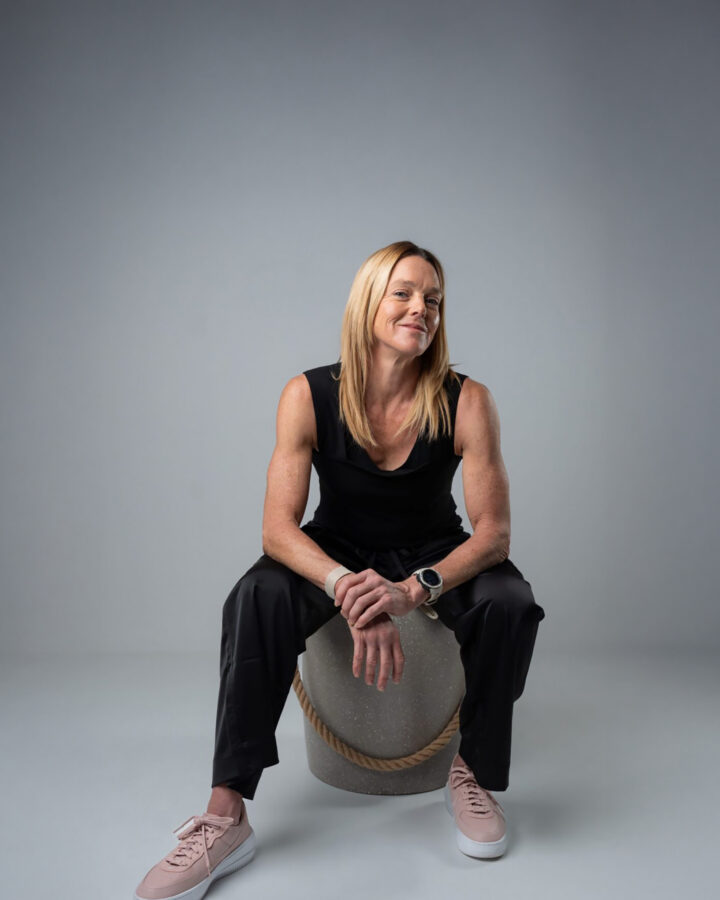
Exercise physiologist and nutrition scientist Stacy Sims is on a mission to help women live longer and stronger through science, and she just signed up for the Super Age Games.
Stacy Sims wants to race bikes against her friends when she turns 107 years old. And the scientist-slash-athlete-slash-author intends to empower every woman to join her for that long-life ride. This November, Sims is gathering an incredible team of women to put their [lon-jev-i-tee]nounLiving a long life; influenced by genetics, environment, and lifestyle.Learn More: Longevity fitness to the test at the Super Age Games.
“I have really fantastic role models… my great-grandmother lived to be 105. My grandmother lived to be 106. My other grandmother was 97,” says Sims, who is now 51 years old. “They were all independently living, and I want to be like that. They all had their faculties. My great-grandmother, you’d walk in her house, and she’d say, ‘we’re playing cards.’”
It’s not just that genetic edge that gives Sims hope for another five decades of activity and independence. It’s also how she’s spent the previous few decades. As a professional cyclist, a PhD researcher, a professor at the Auckland University of Technology in New Zealand, and speaker and author, Sims has spent years working to close a gap in scientific research between men and women. Her mission, she says, is to help women understand how different types of exercise, recovery, and nutrition strategies impact their bodies, performance, and longevity.
Now she’ll put all her knowledge and training to the test — and almost certainly inspire other women — at the Super Age Games, where she’ll be a Founding Athlete.
Showing the Longevity Science World that “Women Are Not Small Men”
When Sims was racing bikes professionally and tackling Ironman triathlons in the late ‘90s and early 2000s, the coaching advice and training schedules she and her fellow competitors were given didn’t account for one important factor: The riders were women, and the plans they were given were designed for men.
“[The training plans] didn’t account for mood, menstrual cycle, or any of the other things that I know affect systems of the body… it started becoming this conversation in the female peloton,” she says. At the time, Sims was pursuing her PhD, as were many of her fellow racers. “We’d get into these deep conversations, going ‘why is this not in the coaching, when we see it in our academic studies and research that men and women have different responses?’”
This experience of having men’s research applied to women’s bodies reflected the reality of exercise science research: Only about 6 percent of all sports science studies are conducted on female athletes alone. Much of what’s known about improving performance, then, comes from studies on men.
That means that lots of the advice women receive is actually counterproductive. And it’s not just a problem for elite athletes. One example Sims points out: When combined with regular exercise, [in-ter-mit-nt fas-ting]nounAn eating pattern alternating between fasting and eating periods.Learn More: Intermittent Fasting can disrupt the release of women’s sex hormones and disrupt their menstrual cycles, yet it’s become known to the general public as a way for everyone to lose weight. It’s discrepancies like this that have led Sims to adopt the professional mantra, “Women Are Not Small Men.”
As research on longevity and aging expands, Sims says the same type of research gap is forming: “If we look at aging well and aging the way we want to, maybe one percent of the longevity research is done on active women, if that.”
The result, she says: Advice that ignores women’s unique problems.
“We’re all coming out and saying that women need to lift on the heavier side of things. We get backlash from the bros in the strength community because they say, ‘No, you can build muscle at any rep range,’” she says. For men, that’s true: Studies have found that when men lift an equal total volume of weight across sets, they build the same amount of muscle, whether they’ve done fewer reps of a higher weight, or more reps with a lower weight.
“There is a sex difference in aging and the way muscle responds with a deceleration of sex hormones… the problem is, women lose strength and power first, and then we have cell death of [leen mas]nounMuscle and other non-fat tissues that contribute to physical function.Learn More: Lean Mass,” Sims says. To counteract that, she says, women need to focus on maintaining power with rep ranges of one to eight reps per set when they strength train — which requires heavier weight. “We need to take a step back and look specifically at those sex differences that happen with the muscle, muscle tissue, muscle cells, neural connections, all of those things.”
She worries that with the advent of AI, the prevalence of this type of misinformation could get worse. Chatbots like Claude and ChatGPT just synthesize and summarize what’s already out there, meaning that for most female fitness questions, they’re pulling from studies on men.
Sims is fighting against this misinformation, and the general dearth of longevity knowledge about active women, with a multi-pronged approach: She’s working on a new book about longevity for active women called Extend, and appears on podcasts on an almost weekly basis to help spread the word about the research that does exist.
She’s building a broader base of research, and helping women search it, with the development of Collective X Health. Formed with three co-founders, Collective X Health will help provide funding grants for female-focused research, and serve as a platform for researchers, coaches, and athletes to search the research that currently exists. Unlike with AI searches on general platforms, these searches will only source information that’s pertinent to women.
And she’s helping to train the next generation of researchers not just to look into what’s happening with women’s bodies, but how to think and talk about that research in ways that put women at the center of the thought process.
“I was editing one of my PhD students’ manuscripts yesterday, and she was very passive in her language and putting more of a patriarchal voice forward,” she says, adding the blunt and somewhat colorful framing: “I’m very bullish on the tone… this is going to be rude, but I don’t want you to think ‘dicks over tits.’ I want you to put your tits forward and talk about it like that.”
Putting Her Training to the Test at the Super Age Games
This November, Sims will join a different type of research community: the Super Age Games.
At the Games, researchers from the Buck Institute for Research on Aging will gather data from participants to help them advance the science of healthy aging. They’ll use this data to build recommendations and studies that will help all Super Agers live longer, healthier lives.
But that wasn’t the first reason Sims became one of the Games’ Founding Athletes.
“This so appeals to the competitive nature in me… I get to train really hard with friends, but for a purpose,” the one-time pro athlete says. “I want something that’s going to push me to work on my weaknesses.”
It’s hard to see how Sims can have many weaknesses to work on: Each week, she does three lifting sessions focused on heavy loads, a high-intensity interval or metabolic conditioning session, and cardio endurance sessions consisting of two to three days of bike rides in nature. She calls these “soul food.”
Sims jokes that the Games biomarker she’s most nervous about is cognition — mostly because she’ll be battling jet lag after the flight from New Zealand. But it’s the marker she said she’s most focused on to emulate the eye-popping longevity of her centenarian grandmothers. And while she progresses to that far-off finish line, Sims intends to keep spreading the word about how women can live longer and stronger.
“We need to lean into lifting and pushing and pulling and balancing and doing all the functional movements,” she says. “I think about what longevity was, and how people think you can’t build bone mass when you get a diagnosis of osteoporosis. Cardiovascular health: Same thing. There are lots of things you can do.”
Read This Next:
The information provided in this article is for educational and informational purposes only and is not intended as health, medical, or financial advice. Do not use this information to diagnose or treat any health condition. Always consult a qualified healthcare provider regarding any questions you may have about a medical condition or health objectives. Read our disclaimers.
Written By:
