2026Athlete Guide
Event information & trials rulebook
- Saturday, November 7, 2026
- The Armory, Washington Heights, NYC
Getting to the Games
The Super Age Games is on Saturday, November 7, 2026 at the Armory. Please arrive at least one hour before your wave start time so you have enough time to move through Athlete Check-In and be in place for your wave start.
- Venue
- 216 Fort Washington Ave, New York, NY 10032
- Entrance
- On Fort Washington Ave, between W 168th St and W 169th St
- Drop-off
- 710 W 168th St, New York, NY 10032
By public transit
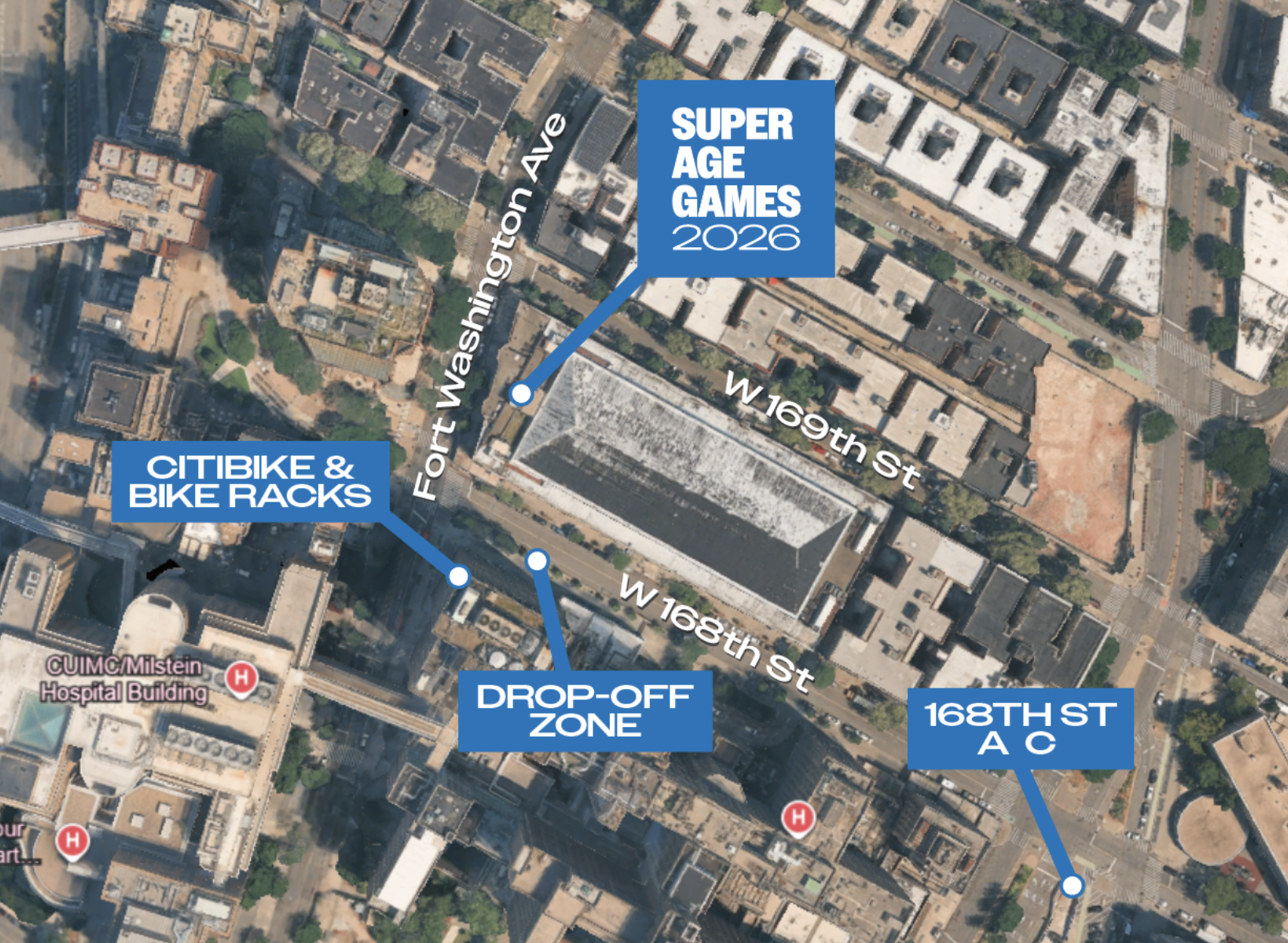
The 168th St AC station is one block from the Armory entrance. Once you exit, head west to Fort Washington Ave, between W 168th St and W 169th St.
By bike or micromobility
There’s a CitiBike dock at W 168th St and Fort Washington Ave, as well as bike racks. We’re unable to provide bike or scooter valet at this year’s event.
Car drop-off (Uber, Lyft, taxi)
Use W 168th St to drop off athletes and spectators, since Fort Washington Ave gets very congested with nearby hospital traffic. Drop-off address: 710 W 168th St, New York, NY 10032.
Event overview
Day schedule
Saturday, November 7
- Athlete check-in opens
- Doors open to athletes & spectators
- Super Age Village opens
- First athlete wave starts
- Last athlete wave begins
- Venue closes
Wave schedule
Athletes start in waves every 10 minutes, from 8:00 AM to 4:00 PM. Your wave number and start time will be emailed to you before the Games.
Report to the staging corral by your corral time, 20 minutes before your wave starts. Allow time before that to move through Athlete Check-In, drop your bag and warm up.
- Wave 1Corral Start
- Wave 2Corral Start
- Wave 3Corral Start
- Wave 4Corral Start
- Wave 5Corral Start
- Wave 6Corral Start
- Wave 7Corral Start
- Wave 8Corral Start
- Wave 9Corral Start
- Wave 10Corral Start
- Wave 11Corral Start
- Wave 12Corral Start
- Wave 13Corral Start
- Wave 14Corral Start
- Wave 15Corral Start
- Wave 16Corral Start
- Wave 17Corral Start
- Wave 18Corral Start
- Wave 19Corral Start
- Wave 20Corral Start
- Wave 21Corral Start
- Wave 22Corral Start
- Wave 23Corral Start
- Wave 24Corral Start
- Wave 25Corral Start
- Wave 26Corral Start
- Wave 27Corral Start
- Wave 28Corral Start
- Wave 29Corral Start
- Wave 30Corral Start
- Wave 31Corral Start
- Wave 32Corral Start
- Wave 33Corral Start
- Wave 34Corral Start
- Wave 35Corral Start
- Wave 36Corral Start
- Wave 37Corral Start
- Wave 38Corral Start
- Wave 39Corral Start
- Wave 40Corral Start
- Wave 41Corral Start
- Wave 42Corral Start
- Wave 43Corral Start
- Wave 44Corral Start
- Wave 45Corral Start
- Wave 46Corral Start
- Wave 47Corral Start
- Wave 48Corral Start
- Wave 49Corral Start
Show all 49 wavesShow fewer waves
-
Pick up your bib at Athlete Check-In
Your bib number and any spectator passes are waiting at Athlete Check-In. Have your registration QR code ready. Event staff and ambassadors will be around the venue all day to help with questions.
-
Spectator tickets at the door
Friends and family who don’t have a spectator pass yet can buy spectator tickets at the door.
-
Keep your bib visible
Wear your bib on your chest or upper leg, visible at all times while competing. This is how we track your scores. Pins are available at Athlete Check-In, and if you lose your bib, Solutions will issue a new one.
-
Bag check is on the third floor
Reach it through the Super Age Village. Only athletes can access bag check; for security reasons the general public can’t pick up items.
-
Keep track of your gear
If you bring your own gear for the trials, such as a water bottle, sweat towel, chalk or fuel, you’re responsible for it throughout the trials. We recommend a small bag labeled with your name and bib number in case anything gets misplaced.
-
Warm up on the second floor
Athlete-only restrooms, changing areas and a warm-up and cooldown area are on the second floor. Use the floor space there for your warm-up routine.
-
Read the rulebook before you arrive
Staff will explain the rules at each trial, but knowing them ahead of time keeps anything from affecting your results. Read the trials rulebook.
-
Complete the trials in order
Hydration stations are in the Trials space and restrooms are just outside the track. Once you finish, head to the Recovery Zone for hydration, fuel and other recovery services.
-
Results 15 minutes after the Super 800
Your Super Age Score and raw trial results are ready 15 minutes after you finish the Super 800. Scan the QR codes posted around the venue, and watch your inbox for them after the event.
In case of a medical issue, alert the nearest Super Age Games staff member. A medical team is on site throughout the day.
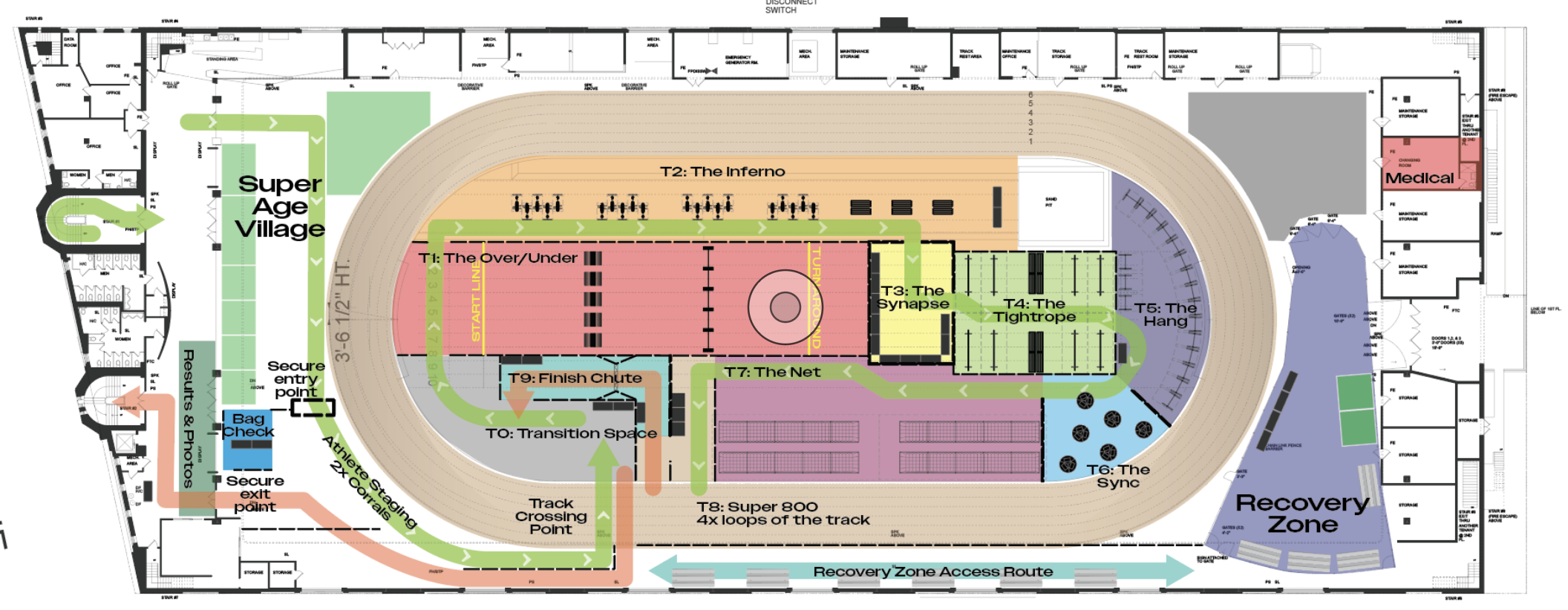
Event map
First floor entry
Competition floor (third floor)
Trials order
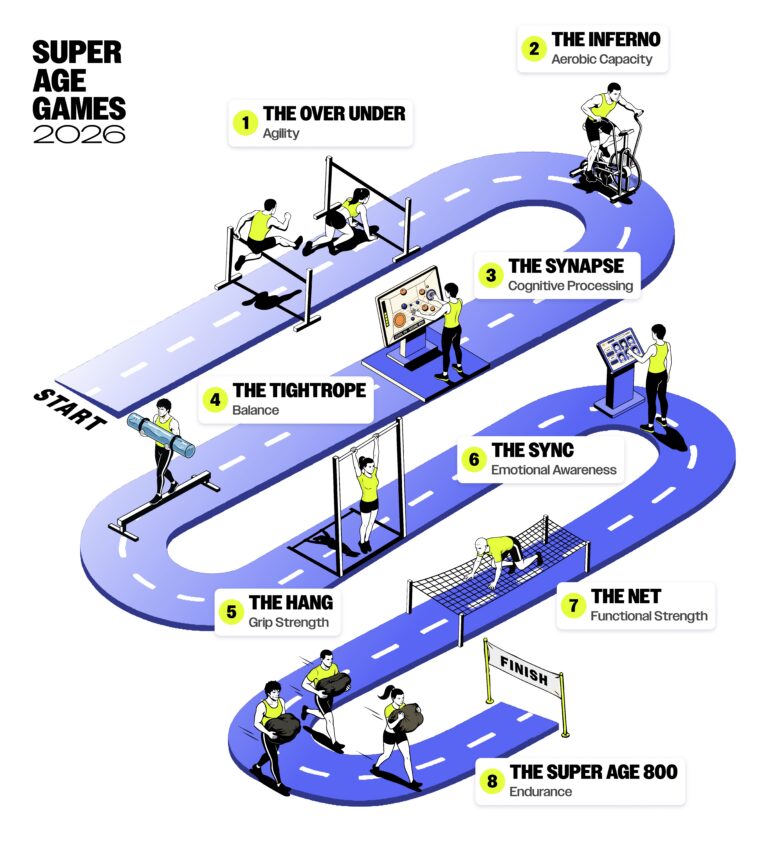
You’ll move through the eight trials in this order. Select a trial to jump to its rules.
Scoring & results
How scoring works
The Super Age Games are scored differently from a race. Every result is compared with Super Agers of your own sex and age. How well you stack up against your cohort’s average result across all trials is the main factor in your overall score, which means a 72-year-old and a 38-year-old are on even footing when it comes to earning a top score.
Your trial scores
Each trial score runs from 5 to 100 and works like a percentile. A score of 72 means you outperformed about 72% of Games athletes of your sex and age. A score of 50 means you performed right on pace for a Super Ager of your age.
That comparison group matters. Super Age Games athletes are a remarkably fit, self-selected group, far fitter than the average American of the same age. Scoring 50 here is a strong result, and scoring higher puts you among the fittest people of your age anywhere.
How the expected result is set
To set what’s expected at every age, we fit a line through the results of the whole field for each trial, separately for women and men. The line is made of two straight segments that meet at age 60, so it can capture performance changing faster later in life, and it lets results spread out more at older ages without skewing the data across younger cohorts. For timed and distance trials, scoring works on a ratio basis, so a 10% improvement counts the same whether you’re fast or slow.
A few safeguards keep the scoring fair. Results far outside the normal pattern are still scored, but left out when we set the line, so one unusual result can’t distort everyone else’s scores. Everyone who completes a trial scores at least 5 (because let’s be honest, these trials are hard).
Your Games Score
Your Games Score combines your eight trial scores into one number, using these weights:
| Trial | Weight |
|---|---|
| The Inferno | 18% |
| The Hang | 16% |
| The Tightrope | 12% |
| The Net | 12% |
| The Over Under | 11% |
| The Super Age 800 | 11% |
| The Synapse | 10% |
| The Sync | 10% |
Because it’s an average, your Games Score is a different kind of number from your trial scores. It isn’t a percentile, and averages naturally sit closer to the middle, so a Games Score in the high 60s can place you near the top of the field. Your rank shows exactly where you stand.
Athletes must complete at least 5 trials to receive a Games Score.
Your rank
You’ll be ranked overall and within your cohort. To win, you need to complete all eight trials. Athletes who complete fewer trials still receive scores for every trial they finish; their Games Scores are removed from the general dataset and marked with an asterisk (*). Ties are marked with two asterisks (**).
Team scores
Teams are two or more athletes of any age and sex. Your team score is the average of your team’s Games Scores, and because every Games Score is already adjusted for age and sex, a 65-year-old and a 35-year-old make as strong a pair as two athletes of the same age. Each member still receives their own individual results and cohort rank; being on a team doesn’t change your personal score.
Skipped trials and accommodations
Super Agers aren’t a monolith, and longevity isn’t reserved for the fully able-bodied. If a disability, injury or medical condition means you’ll skip a trial, tell us on the Games Longevity Quiz. That trial’s weight is removed from your Games Score so your number reflects what you did, not what you couldn’t. Because the overall title requires all eight trials, athletes who skip a trial are scored and ranked but aren’t eligible to win overall; they can still place within a trial.
After the Games
Your initial raw scores will be available on Games day. Footage and images from Games day will be emailed on November 8, and adjusted results arrive by email within 7 days.
Your scores compare you with the athletes at this year’s Games, and they’ll stay exactly as they are. Next year’s Games will set its own standard from its own field, so the best way to track your progress year to year is your raw results: your times, distances and holds. We’ll include those in your results email.
By competing, you’re also helping build something new. Each Games adds to a growing picture of what strong, healthy aging looks like, and that knowledge helps the whole longevity community.
Super Age & longevity prediction
Your Super Age
Alongside your Games results, you’ll receive your Super Age: your fitness age compared with the general US population. Your Games scores compare you with fellow Super Agers. Your Super Age answers a different question, which is how your aerobic fitness compares with people across the country.
Your Super Age is the age at which a typical American would have your estimated aerobic fitness. It uses the fitness age approach developed by researchers at the Norwegian University of Science and Technology, compared against US norms from the FRIEND registry, and it draws on your Inferno result and your Games Longevity Quiz answers. Super Ages are shown up to 10 years younger than your actual age; results beyond that appear as “10+ years younger,” since results beyond a decade are unreliable.
Your Super Age is an estimate of fitness paired with the impact of your daily habits. It isn’t a medical test or a measure of how your body is aging at a cellular level.
Your Longevity Prediction
Your Longevity Prediction starts from the average remaining lifespan for someone of your age and sex in the Social Security Administration’s life table. Your Games Longevity Quiz answers adjust that baseline for habits and history with established links to lifespan. Your measured aerobic fitness then adds resolution to your prediction, drawing on long-term cohort research.
It’s shown as a range because every input carries uncertainty. Two athletes with identical results can receive different predictions because the starting point (life expectancy) differs by age and sex, and because the quiz adjustments differ.
Trials instructions & rules
Trials overview
Your Games at a glance
You’ll move through all eight trials in a scheduled wave, with untimed rest between trials so you can recover and give each one your best effort. Expect to spend 1 to 2 hours completing all the trials. Your wave and start time will be emailed to you in advance, so there’s no need to arrive hours early to secure a good slot.
Bring comfortable training clothes and shoes that allow for mobility and flexibility. We also recommend bringing a water bottle with your name on it.
Games Longevity Quiz
Before Games day, each athlete completes the Games Longevity Quiz. The lifestyle and health data from this quiz is needed to calculate your Super Age and Longevity Prediction. We’ll send the quiz by email ahead of the Games. You must complete it before Games day; athletes without a completed quiz can’t receive a Super Age.
Your cohort
Your results will be measured against a cohort defined by sex and age decade, for example women aged 50 to 59. Your cohort is the group you’re ranked within, and it’s also part of how we keep comparisons fair across all ages in the final ranking.
The eight trials
Each trial measures a different marker linked to a long, healthy life. Judges at every station will brief you before you start, and your result will be shown to you before you leave the station so you can confirm it on the spot.
Trial 1: The Over Under
Longevity marker
Agility: How fast you can move matters as much as how far you go.
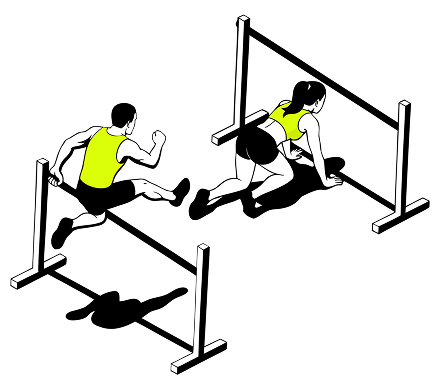
The Over Under tests dynamic agility: the ability to change direction, shift body position and keep moving through a course that asks the body to adapt in real time.
What you do
Navigate a custom course of boxes and low bungees set 30 ft apart, alternating between getting over a 42″ box and crawling under an 18″ bungee. Complete the course there and back twice to finish.
Scoring & rules
Time to completion; faster is better.
- Athletes with accessibility needs can use the foothold near the base of the “over” block.
- The “under” portion must be done lying with your chest on the ground, in a crawl motion.
Trial 2: The Inferno
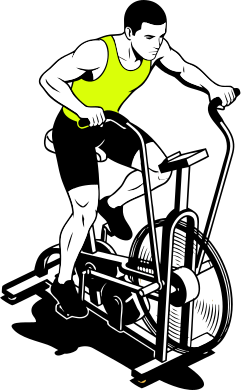
Longevity marker
Aerobic capacity: Your lungs do not lie.
The Inferno is a proxy for VO2 max, the single strongest modifiable predictor of longevity we have.
What you do
Push as hard as you can for four minutes on an air bike, pedaling at your strongest sustainable effort.
Scoring & rules
Average wattage output over 4 minutes.
- The four minutes can’t be paused once started.
- The trial tracks all four minutes of effort; any zeros (from stopping) are included in the final score.
Trial 3: The Synapse
Powered byNeuroTracker
Longevity marker
Cognitive processing: Your brain is an athlete too.
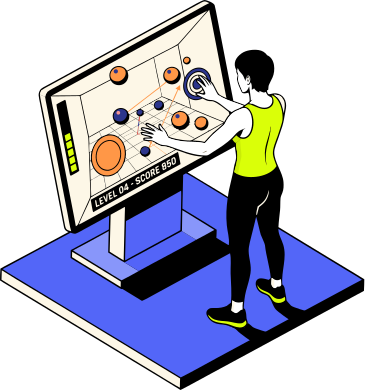
The Synapse uses 3D Multiple Object Tracking (MOT), a research-validated method for measuring cognitive processing speed, attention and working memory under pressure. NeuroTracker, a founding partner of the Super Age Games, powers this trial.
What you do
Test your cognitive abilities by tracking multiple moving objects on screen at once as the difficulty level increases.
Scoring & rules
Your score is level-based: the further you advance, the higher the score.
- Only one full session per Games day; the test can’t be redone for a higher score.
- Athletes with vision issues can ask the trial scorers for an adaptive version of the test.
Trial 4: The Tightrope
Longevity marker
Balance: Proprioception, your body’s internal GPS, is one of the most underrated longevity markers.
The Tightrope adds load, movement and direction to give a richer picture of your neuromuscular health than a static standing test can.
What you do
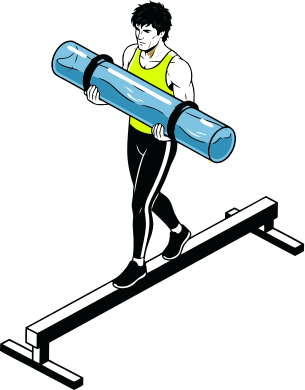
You have two minutes to traverse a 12 ft long, 4″ wide low beam, walking forward and then backward while carrying a 15 lb water-filled tube in a front rack position. Falls send you back to the start.
You face the same direction the entire time: walk forward to the end of the beam, then walk backward to the start without turning around.
Scoring & rules
Your score is based on the maximum continuous distance covered during your two-minute session.
- Shoes must be off; athletes without socks will be given disposable socks. Grippy or pilates socks aren’t allowed.
- The water tube must be held upright against your chest; no other method can be used.
- If the tube is dropped, your score is taken from where you dropped it.
- Scores are recorded from where your rear foot last touched the beam.
Trial 5: The Hang
Longevity marker
Grip strength: A key marker of strength and predictor of longevity.
The Hang goes beyond grip. It’s a window into total-body muscular health, cardiovascular status and neurological function.
What you do
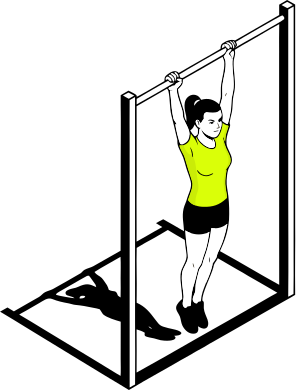
Dead hang from a bar with controlled form, no swinging or kipping.
Scoring & rules
How long you can hang. Your time ends when you let go, and the longer you hang, the better.
- Overhand grip only. Thumb position is up to you.
- The hang must be a static hold; no kipping or swinging.
- Chalk (liquid and solid) will be available.
- Gloves, including fingerless gloves, aren’t allowed.
Trial 6: The Sync
Longevity marker
Relational capacity: Connection is a longevity marker.
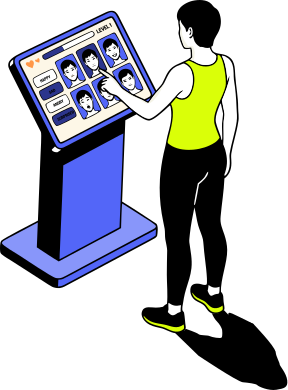
Developed in partnership with the Paul Ekman Group, The Sync measures emotional awareness at the level of micro-expressions and nonverbal cues, the perceptual foundation of human connection.
What you do
Two rounds: first you’ll identify 14 micro-expressions, then you’ll respond to five social situations.
Scoring & rules
The more accurate your answers, the better your score.
- Only one full session per Games day; the test can’t be retaken for a higher score.
- The test takes around 2 minutes to complete.
Trial 7: The Net
Longevity marker
Functional strength: Strength that translates to everyday tasks and movements.
The Net requires coordinated, multi-directional strength, without any single dominant muscle group doing all the work.
What you do
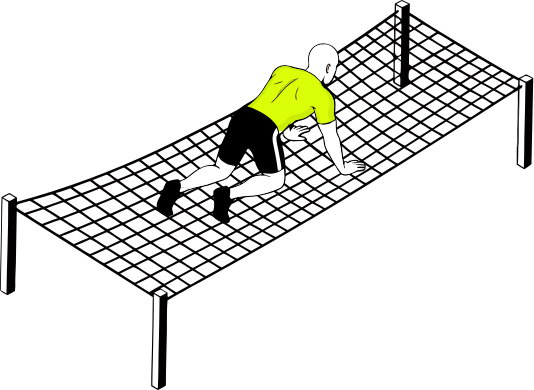
Crawl across a 40 ft horizontal cargo net suspended 5 ft off the ground, tap the yellow bar, turn around and return to the start.
Scoring & rules
Time to completion; faster is better.
- You have five minutes to complete the trial. Athletes who go past five minutes will be asked to step off the net and receive 5 minutes as their final score.
- Once the trial has started, you can’t touch the frame. Your hands, feet, knees and elbows can all be used on the net.
- Fingerless gloves are allowed.
- No rolling.
Trial 8: The Super Age 800
Longevity marker
Endurance under load: The ability to sustain movement while bearing a load is a direct measure of functional independence.
The Super Age 800 is a convergence trial. It loads your cardiovascular system, tests muscular endurance under an external load and measures your ability to hold pace while carrying weight. The 800 asks: what’s your pace when the load is real?
What you do
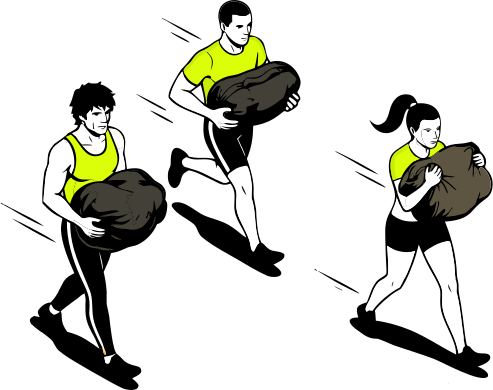
Walk or run 800 meters (four laps of the track) carrying a sandbag at your chosen weight: 15, 25 or 35 lb.
Sandbags in all three weights are in the warm-up area, so you can try them and settle on your weight while you warm up.
Scoring & rules
Time to completion; faster is better. Your finish time is adjusted by a weight multiplier, so a heavier load earns a better adjusted score.
| Sandbag | Time multiplier |
|---|---|
| 15 lb | ×1.000 |
| 25 lb | ×0.917 |
| 35 lb | ×0.842 |
- You must finish with a sandbag for your score to count. Starting without a sandbag, or finishing without one, earns the lowest score of 5.
- Whatever weight you start with, you carry back to the start.
- You can carry the sandbag in any position.
- If you can’t finish with the weight you chose, you can swap it for a lighter sandbag at the trial station between laps. Swaps can only go down in weight, and your timer keeps running during any swap.
- For safety, dropping or leaving a sandbag on the course disqualifies you from this trial, and your result won’t count.
- Gloves, including fingerless gloves, aren’t allowed.