

This Buck Institute Doc Says Longevity Is About Feeling Better Right Now, Not In 50 Years
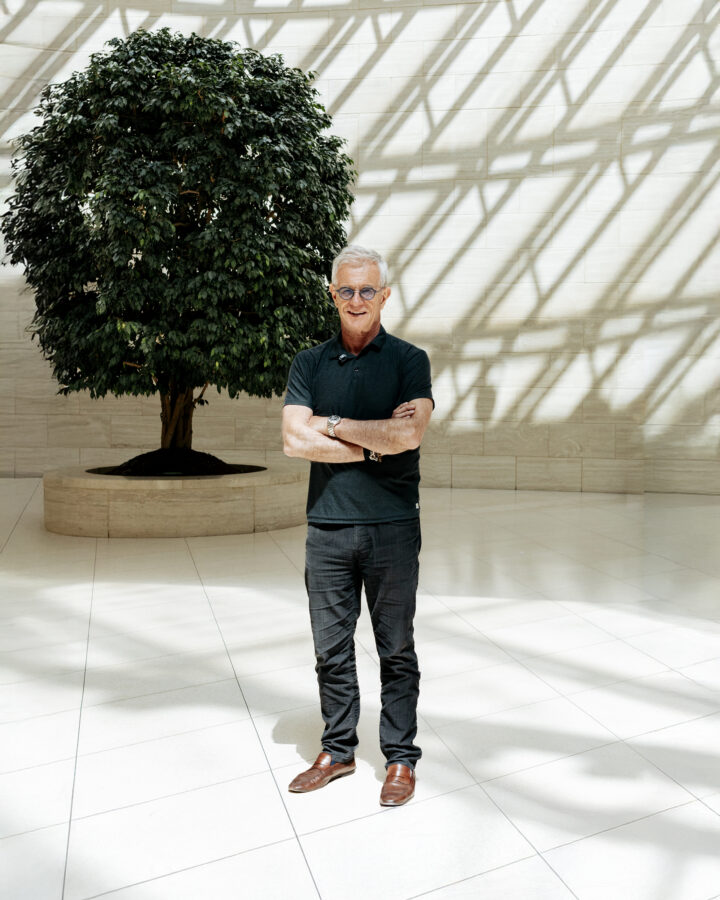
Eric Verdin runs the Buck Institute for Research on Aging. The goal of his [lon-jev-i-tee]nounLiving a long life; influenced by genetics, environment, and lifestyle.Learn More: Longevity efforts? Living better starting today.
When he’s not running the world’s first biomedical research institution focused on aging research, Eric Verdin spends his time on a hobby that, if anything, could shorten his life: racing cars.
Verdin, the president and CEO of the Buck Institute, has been spinning laps in karts and Le Mans-style race cars for the past nine years. Despite the danger, the Belgian-born longevity doc doesn’t think his career and hobby are at odds.
“I think they’re completely aligned, for a number of reasons,” he says. Racing, he says, has given him a reason to exercise and stay in shape. It’s helped him build community and social connection with his fellow drivers, an important aspect of healthy longevity. Most important to him, though, is that it keeps him striving to get better. “The essence of aging is always challenging yourself and learning new skills… nothing is ever ‘too late’.”
At the Buck Institute, the 69-year-old is used to challenging convention: The research conducted at the Bay Area facility focuses not just on the biology of age-related disease, but on the biology of aging itself. Verdin isn’t prone to hyperbole about aging research — he points out that people who predict that we’ll all soon live to 140 are doing so completely without evidence — but he believes that the experiments Buck researchers are undertaking could help humans break through the current lifespan ceiling of 115-ish years.
Like racing cars, making this type of medical history is a challenge he relishes. And now, he’s signed up for another: Verdin plans to challenge himself, and his own progress against aging, as a Founding Athlete at November’s Super Age Games.
Why Longevity Is About Here and Now, Not Just Years In the Future
When Verdin became head of the Buck Institute, he believed the goal of longevity research and practice was extending life and [helth-span]nounThe number of years you live in good health, free from chronic illness or disability.Learn More: Healthspan. In the Institute’s Verdin Lab, he and his colleagues study worms, mice, and models of human systems to see how immune systems age, and how nutrition activates (or doesn’t activate) chronic [in-fluh-mey-shuhn]nounYour body’s response to an illness, injury or something that doesn’t belong in your body (like germs or toxic chemicals).Learn More: Inflammation, a condition that leaves people vulnerable to cancer, diabetes, cardiovascular diseases, and premature cellular aging.
But Verdin says that these days, it’s important to him not just to study aging conceptually. He puts himself in the shoes (and at the kitchen tables, and in the workouts) of his research subjects.
“I want to be able to speak from personal experience about what I describe that people should do… I love self-experimentation, so I’ve done a lot of it,” he says. “I’ve tried drugs. I’ve tried interventions. Everything you can read about on social media about aging, I pretty much have done it.”
What he’s learned from these self-experiments, though, isn’t just what’s worked and what hasn’t. Verdin says it’s taught him a completely different way to think about longevity.
“The goal, initially, was I want to be able to speak for the field, and I want to live longer,” he says. “What I’ve discovered instead is that it’s about the here and now… it’s about the fact that ever since I’ve been on this journey, I’ve been feeling better and better and better.”
Part of his formula for all that feeling better is exercise. Every other day, Verdin does hot pilates, combining the [hahrt helth]nounThe overall condition and function of the cardiovascular system, including blood pressure, cholesterol, and arterial health; critical for longevity and disease prevention.Learn More: Heart Health benefits of heat with strength and flexibility. A few times per week, he hikes with a weighted pack, piling the benefits of outdoor exercise onto his cardio session, and the metabolism-boosting benefits of adding external load to his endurance work. He’ll also slip in a bike ride of a few hours per week, and train for a challenge — a climbing trip, for instance, or his next auto race.
He’s doing all of this approaching 70 — an age at which, he says, many of his friends are “letting the old man in.”
“They’re sitting up from a chair, and they make noises. They tell me, ‘oh, I’m not what I used to be.’ All of this seems completely foreign to me,” he says. “I feel better than I have my whole entire life. And when I say I feel better, it’s not just subjective. I’m in a better mood. I’m more optimistic.”
Extending His Self-Experimentation As a Super Age Games Founding Athlete
The Super Age Games will give Verdin another way to see how “not subjective” his results are. At the November event in New York, the aging doc will lead a team of his Buck colleagues.
“I’m the boss, so I have to lead by example,” he says with a laugh. “I know the weight I carry as the head of the Buck; participating in these Games tells people, ‘He’s not just talking about it. He’s drinking the Kool-Aid.’”
The Institute will also gather data at the event. Many scientific studies on longevity are based on populations who are (or were) sick. But at the Games, Buck scientists can grab juicy data from a wide range of people, including those at the healthiest end of the spectrum. The data from the Games could provide some small, but potentially valuable, extra wrinkles of inspiration.
For Verdin, the data’s beside the point. The real inspiration he’s looking for — and that he wants his colleagues to look for — is from the participants. Whether you’re coming with a team or showing up solo and finding your group at the Games, you’ve got something important to add, he says.
“The major motive is not so much to get data,” he says, “It’s to be part of the discussion and the community. To participate in a community that has this idea in mind is inspiring.”
Ultimately, he hopes the Games, and the stories that come from it, get even more people involved in working towards their own healthy longevity — the kind they can enjoy right now.
“That’s one of the things that inspires me the most right now,” he says. “This idea that, all of a sudden, being healthy has become cool.”
Read This Next:
The information provided in this article is for educational and informational purposes only and is not intended as health, medical, or financial advice. Do not use this information to diagnose or treat any health condition. Always consult a qualified healthcare provider regarding any questions you may have about a medical condition or health objectives. Read our disclaimers.
Written By:
