

Want to Know How Well You’re Aging? Draw a Clock
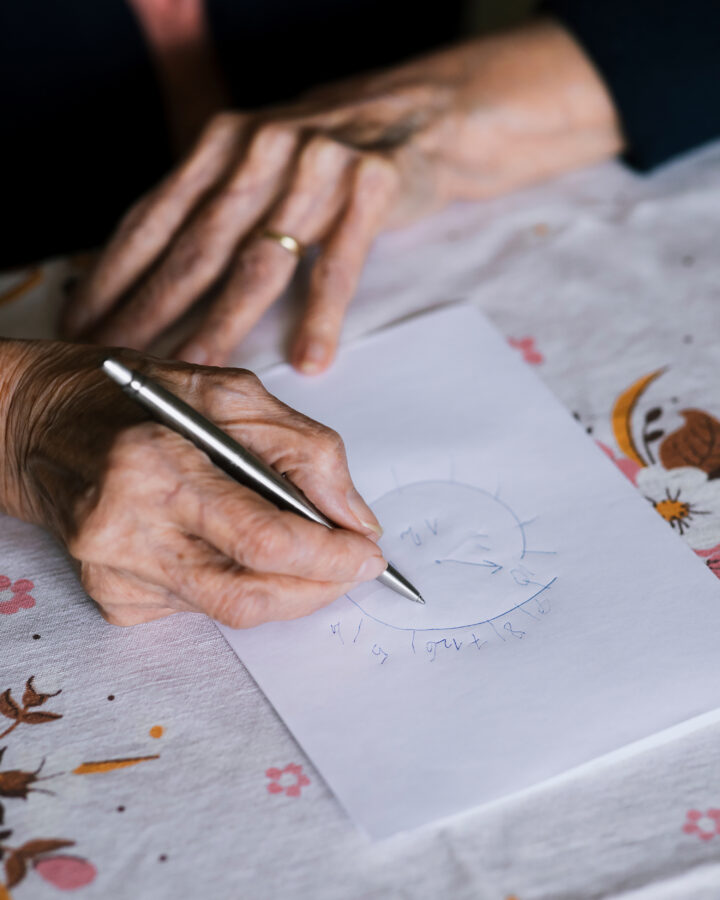
Drawing isn’t just art. For your brain, it can also be medicine.
Here’s something worth knowing: One of the most revealing early screening tests for brain health isn’t a brain scan or a blood test, it’s a pencil and a blank piece of paper. Picture a clock. The time reads 10 minutes after 11. Could you draw it with ease and accuracy?
The results of this seemingly simple screening tool, the Clock Drawing Test, can separate people with mild cognitive impairment or dementia from those with normal cognitive function, research suggests.
“Drawing clocks requires a lot of complex cognitive processes,” said Morris Freedman, MD, FRCPC, FAAN, Professor, Department of Medicine (Neurology) at the University of Toronto and head of the neurology division at Baycrest Health Sciences. You need to use language and memory to follow directions, know the numbers and what they represent, and summon visuospatial skills to draw the numbers in the right places.
And because drawing challenges your brain, it might provide more than a snapshot of your thinking abilities. It could be a brain-building habit to stave off cognitive decline. Here’s what drawing can tell you about your brain, and how it could help you stay sharp.
The Science of Drawing as a Diagnostic Tool
If your doctor suspects abnormal changes in cognition, they may rightly inquire about your medical history and order physical exams, cognitive assessments, brain imaging, or blood tests. The clock drawing test works as a first-pass screener, helping to alert you if these other forms of testing might be needed.
How the test works
“One way that I usually give the Clock Drawing Test is to ask the patient to draw a big round clock, put the numbers in, and then make the hand say 10 after 11,” said Sanford H. Auerbach, MD, a neurologist at Boston Medical Center. For someone with a cognitive problem, it’s a surprisingly tricky task — especially placing the hands correctly.
“The person has to know that the 10 means the big hand goes on the two,” said Freedman. “For people with frontal lobe dysfunction, they get pulled to the 10 instead.”
The errors can be revealing: numbers crowded together, hands pointing the wrong way, clocks left half-finished. Each tells a different story about how the brain is functioning.
The results can also shock people. “A lot of times, there’s a certain element of denial,” said Auerbach, “so it’s helpful to be able to illustrate that.” He often pairs the Clock Drawing Test with the Mini Mental State Examination (MMSE), since together they offer a fuller picture of thinking and executive function — the ability to solve problems, make judgment calls, and stay mentally organized.
“The Clock Drawing Test is much more sensitive than people would think,” he said. “If you have a conversation with somebody, you might be surprised at how many difficulties they would have with this clock drawing.”
That said, Freedman is clear about its limits. “Clocks give you a lot of information, but they’re a screening tool. I wouldn’t make a diagnosis on the basis of a clock.”
A test with an expiration date?
Not everyone who struggles is showing signs of decline. New research suggests Gen Z actually performs worse than older adults on the Clock Drawing Test — simply because they grew up reading digital, not analog, clocks.
“We started noticing that younger adults weren’t so good at drawing clock faces because they didn’t grow up learning to tell time with them,” said Richard B. Lipton, MD, of Albert Einstein College of Medicine. It’s a reminder that context matters — and it may signal that the test itself has a limited future. Symbol search tests, which ask users to match unfamiliar shapes on a digital screen, could eventually take its place.
Sharpen Your Pencil to Sharpen Your Brain
If drawing can reveal [kog-ni-tiv helth]nounThe ability to think, learn, and remember clearly as you age, supported by brain structure, function, and lifestyle factors like sleep, diet, and exercise.Learn More: Cognitive Health, can it also build it? This is where the science gets exciting. Early research suggests the answer is yes, and not in a small way. Visual art therapy has been shown to help older adults improve memory, sharpen attention, reduce depression and support cognitive health.
That same study notes that creating art may increase gray matter density and strengthen neural connections in the cerebellum and frontal lobe, regions that help govern executive function.
Drawing may also bolster the mind in ways that are harder to measure. One small study published in Research on Aging found that older adults who drew every day said it helped them feel more present and grounded — much like meditation, but with a pencil in hand. In fact, nearly three quarters of participants reported slipping into a “state of flow” — that absorbed, time-dissolving feeling where the outside world goes quiet. Certain techniques helped get them there faster: focusing on texture, tracing negative space, or simply choosing a subject they loved.
Mariya Vodyanyk, PhD, co-author of the study, notes that the study was small and her team was careful not to overclaim cognitive benefits. But the idea that sitting down to sketch could double as a kind of moving meditation? That’s worth something on its own.
Drawing Exercises For a Cognitive Challenge
You don’t need talent, training, or tidy lines. The whole point is to show up curious and let your hand follow your eye. Here are three techniques that researchers used to help people find their flow. They require nothing more than a pen and something worth looking at.
Drawing is a skill that can be improved with practice. Vodyanyk teaches older people to draw with pens, not pencils with erasers. “It’s better to work through mistakes and then move on and try again,” she said, offering the following techniques:
- Blind contour: Without looking at the paper, slowly outline an object using a single, continuous line. “This exercise teaches people to slow down their eyes to observe details, and then also to sync that hand-eye coordination,” Vodyanyk explains.
- Gesture drawing: Quickly sketch an object in motion in less than 30 seconds. Focus on how objects relate to each other in space, not on fine details. “Making multiple quick sketches is useful for building drawing skills and developing and training cognition,” the researcher says.
- Negative space drawing: Instead of drawing an object, draw the spaces surrounding it. “Think about how your attention shifts to the spaces around the object rather than the object itself,” she advises.
If drawing isn’t your thing, try another hobby that requires your brain to process information and convey instructions to your hands – like writing, crossword puzzles, or chess. “Anything that keeps your mind active and poses a challenge is good for brain function,” said Freedman, whose research suggests that speaking a second language could also delay the onset of dementia.
Your Brain, Your Move
Freedman is also quick to zoom out: Drawing is just one piece of a larger picture. A landmark 2024 Lancet Commission paper identified more than a dozen modifiable risk factors for dementia, things like managing blood pressure, staying physically active, protecting your hearing and vision, and keeping cholesterol in check. The encouraging takeaway: most of them are within your control.
The best thing about the science here is that it hands you something actionable. Whether you’re picking up a pen for the first time or just looking for a new way to keep your mind engaged, drawing is a low-stakes, high-reward place to start.
If you’re curious about where your cognitive health stands, free self-assessments like Cogniciti (developed by a team at Freedman’s medical center) and the Montreal Cognitive Assessment (MoCA) Health Assessment Index are worth bookmarking. And if something feels off — thoughts that are harder to find, familiar places that feel less familiar — your doctor is the right next call. Catching changes early, it turns out, is one of the smartest things you can do for your brain. Much like drawing itself.
The information provided in this article is for educational and informational purposes only and is not intended as health, medical, or financial advice. Do not use this information to diagnose or treat any health condition. Always consult a qualified healthcare provider regarding any questions you may have about a medical condition or health objectives. Read our disclaimers.
Written By:
