

Want Strength and Vitality? Stop Ignoring Your Glutes
Edu Bastidas + David Garcia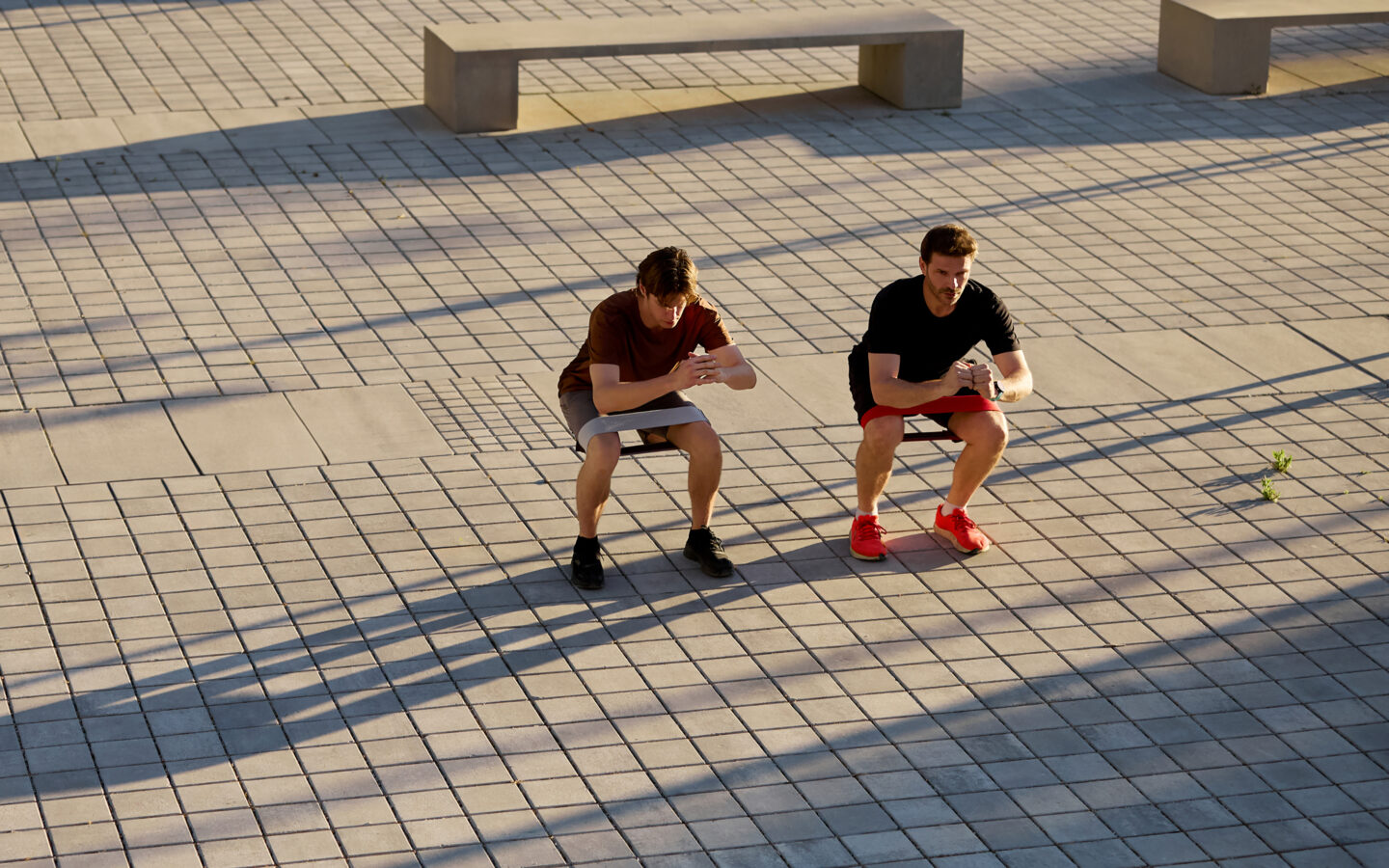
Your glutes are your primary engine for movement, balance, and power. Here’s how to train them for the long haul.
If your social algorithms feed you fitness content, then you know butts are the new biceps, with both men and women working to strengthen their glutes.
But this isn’t just an aesthetic moment.
Your glutes are important for long-term fitness and aging because they’re the foundation of your core strength.
The gluteal muscles are the body’s primary engine for movement. They drive walking, climbing, lifting, standing up, and stabilizing your pelvis with every step. When they work well, movement is efficient and resilient. When they don’t, the body compensates in ways that quietly increase pain, instability, and injury risk over time.
There’s emerging evidence that glute strength is also linked to brain health as we age, adding a neurological dimension to what has long been understood biomechanically. Strong glutes support better balance, more confident movement, and greater independence. All of which matter far more than visible muscle tone.
From a structural standpoint, underperforming glutes create a cascade of problems. Because when your butt’s main muscle, the gluteus maximus, isn’t performing, it creates movement problems and pain in all the other joints of your lower body, says Christopher Powers, Ph.D., DPT, co-director of the Musculoskeletal Biomechanics Research Laboratory at the University of Southern California. Powers has studied glute recruitment, and designed a system of exercises doctors can use to help them work better.
“If your butt’s not doing its job, your knee collapses inward. So your hip will internally rotate and that motion creates a lot of problems,” he adds. Those dysfunctions at the hip and knee can result in knee pain, iliotibial (IT) band syndrome, where there’s pain on the outside of the knee and hip, and even increase the risk of a torn ACL.
In this article, Powers and other experts explain why glute function matters so much for [lon-jev-i-tee]nounLiving a long life; influenced by genetics, environment, and lifestyle.Learn More, how to tell whether your glutes are actually doing their job, and how to train them effectively so they keep supporting you as you age.
Use It or Lose It
If you’re at a desk or in a chair at work, in the car on your way to and from that desk, and on the couch in the evening, you’re sitting on your butt a lot, but you’re not using it.
“The gluteus maximus evolved for us to be able to climb and run and chase food,” Powers declares. “The activities that this muscle evolved for, people don’t really engage in anymore on a daily basis, unless they force themselves to exercise and use it.”
When you don’t use it, your brain sort of “forgets about it,” he cautions: “That neural pathway will be abolished, because it’s not being utilized.”
The result has been called “dead butt syndrome” or “gluteal amnesia,” and it’s a situation where your glutes don’t contract and fire during the activities that should recruit the booty.
When they don’t fire, it’s not just that you can’t chase food, adds Brendan Murray, director of sports medicine at Canyon Ranch.
“It’s a big part of your gait, as your glutes are the main part of locomotion going forward.” If your glutes aren’t firing, your hips might rotate you forward instead of extending to push you forward. “If I’m rotating when I’m walking, my tendency will be a little more unsteady. We look at higher instances of falls.”
It may also just cause pain, he says. When your glutes don’t work, some other part of your body takes over: Your low back may take on some of the pressure and work, or your hips may get overused, resulting in pain in one or both areas. Powers tells us that in his practice, dysfunction in the glutes is very common in people with knee or hip pain.
At the risk of scare-mongering, let’s be clear: Powers and Murray both see patients about pain and in clinical settings. For most people, dead butt isn’t a problem, according to Neil Gibson, Ph.D., who has studied how effectively different exercises work the glutes.
“Presuming they can still sit-to-stand, walk, run, and sprint to a degree, their glutes are working … could they work more effectively in coordination with the muscles around them? Probably,” he says. If your glutes are sore after running, squatting, climbing lots of stairs in a day, or doing glute exercises in the gym, chances are, your gluteus is functioning.
But even weak glutes can impair your ability to live well as you age, he cautions. One simple, key test for longevity is being able to stand up on your own. In a 2024 study from the European Journal of Preventive Cardiology, scientists found that the ability to get up off the floor without using your hands makes you six times less likely to die from [hahrt dih-zeez]nounConditions affecting heart health and circulation.Learn More in the next decade. And passing that test of getting up off your butt requires the very muscles inside it.
“That is not exclusively the glutes, but they play a huge part in that movement pattern,” Gibson adds. “So the stronger you are in the lower body musculature, the more you’ll be able to perform those everyday tasks that allow you to live independently for longer, and enjoy your quality of life.”
How to Tell if Your Glutes Are Working
Being able to tell if your glutes are working is simple: If your butt’s sore after a hard run or a butt-focused workout, they’re engaging. But if they’re not, they may not be working right. And before you can strengthen them, Powers says, you’ll need to reactivate them. And the sooner you can resurrect a dead or dying butt, the better.
“If you’re 70 years old and you’ve never really had a butt your entire life, it’s a monumental struggle to get it going again. It’s been seven decades of disuse, and that neural connectivity has been lost,” he puts in. “A lot of times for older adults, just getting them to turn on could take a month or two.”
Two Techniques to Fire Up Inactive Glutes
To keep them firing, or to re-stoke the fire, try these two techniques. Both connect your mind to your muscles through touch. By touching your butt with your hands, you can actively feel when the glutes are flexing, so you start to connect with what it feels like to use your behind to make these moves.
“Later, if I go to do a variation of a squat or deadlift [where I can’t touch it with my hands], I now know what those muscles are, and I can focus on feeling the glutes from the very beginning all the way through the movement,” he clarifies.
Here’s how to employ this “touch and go” technique:
1. Lying Butt Squeeze to Glute Bridge
Starting with this maneuver, Murray says, lets you make the mind-muscle connection while taking your low back out of the picture.
To do it, you’ll lie faceup on your back with your feet flat on the floor, just like the bottom of a situp position. Cup your hands under your lower glutes, where they meet your hamstrings.
Now squeeze your butt so that you can feel them flexing in your hands… but without moving your low back. When you can, Murray tells us this means that you know your glutes, not your low back, are doing the work.
Once you’ve mastered that, turn it into a glute bridge: Continuing to cup your lower glutes, squeeze your butt to straighten your hips so that your body forms a straight line from knees to shoulders. Hold for 20-30 seconds, really focusing on feeling it in your butt. This type of isometric move, where you hold a contraction, can create the prolonged focus and attention that drives muscle memory, Powers says.
2. Sit-to-stand with Glute Touch
Now that you’ve learned to touch your butt to sense it engaging, Murray suggests applying it to standing up out of a chair… one of the key daily moves involving your glutes.
Sitting in a chair, place your hands under the sides of your legs so you can feel where your glutes meet your hamstrings. Squeeze your butt to feel it flexing without moving your low back. Relax, then squeeze it again to stand up out of the chair, feeling the contraction in your glutes as you stand.
Return to a seated position, and repeat 3-4 times. Do this 4-5 times per day, Murray recommends.
The Best Moves to Strengthen Your Glutes
The most effective exercise for the gluteus maximus may be the barbell hip thrust (see instructions in the exercise section below). In a 2023 study, participants were able to grow their lower glutes by 20 percent in just nine weeks of training with this move. And in a study co-authored by Gibson, the hip thrust had the highest correlation to the musculature needed for sprinting—one of the most glute-taxing things you can do.
“That doesn’t mean just do barbell hip thrusts,” Gibson says. “They are part of a well-balanced routine. One of the advantages of the move is there’s no axial loading, so the weight of the bar isn’t going through your back. So most people can load [the hip thrust] to a much greater degree than they can with a back squat.”
A “well-balanced” routine of glute exercises should include training them at least once per week, but more often is better, Murray adds.
“The more often I put load to the muscle, the faster it learns [to keep contracting],” he informs us. Studies also indicate that you’ll build more muscle and strength with more sessions: In an analysis of 10 different studies on training frequency, scientists found that people who trained a muscle group twice per week were able to increase its size by 6.8 percent in 3 months. Those who trained it just once per week only experienced 3.7 percent growth—just over half.
Read This Next
The information provided in this article is for educational and informational purposes only and is not intended as health, medical, or financial advice. Do not use this information to diagnose or treat any health condition. Always consult a qualified healthcare provider regarding any questions you may have about a medical condition or health objectives. Read our disclaimers.
Written By:
